We’re in the fortunate position of getting to travel a lot these days, and we took full advantage of the opportunity last year. Because of the pandemic, we opted to take a couple of epic road trips to primo backcountry destinations that had long been on our to-do list. (Laura’s written a statistical summary of the first half of our trip, but the second half recap is still coming. Stay tuned.)
We’re a single-car household, and while there was some talk about borrowing a beefier ride from generous family members, we wound up taking our only set of wheels: a white 2013 Chevrolet Volt with more than 100,000 miles on it.

If you’re not familiar with the Volt, that’s pretty normal. Chevy did a horrible job of marketing it, and they stopped making new models in February 2019. It’s classified as a PHEV, or a plug-in hybrid electric vehicle, which was a fairly new concept when the first Volts rolled out of the factory in late 2010. Our first-generation model has an electric battery that gets us 30 to 40 miles of gasoline-free locomotion. When the battery is out of juice, a four-cylinder gas engine kicks in to power the electric motor. In theory, you never need to plug in the car and charge the battery – you could just use it like a normal gas-powered car. Conversely, if you only ever took short trips and charged it regularly, you might never need to put gas in it. But in practical terms, we generally use the car to run errands around town using nothing but the battery, and then fall back on the regular ‘ol internal combustion engine for longer trips.
It’s a nifty concept, and it’s a shame Chevy didn’t do a better job trying to explain it to consumers. This sort of advanced-hybrid concept might not make sense to a lot of urban-dwellers, who have plenty of public charging stations that make owning Teslas and other full-blooded electric cars increasingly easy, but it’s a different story in rural South Dakota. We still have a lousy public charging infrastructure in 2022, and we’re far from the only place in the Heartland with a dearth of chargers. It’s difficult to travel through a good chunk of Middle America with an EV – even in a Tesla, which has a damn good charging network. There are plenty of options along the Interstates and near major tourist stops, but too few ways to get juice off the beaten path.

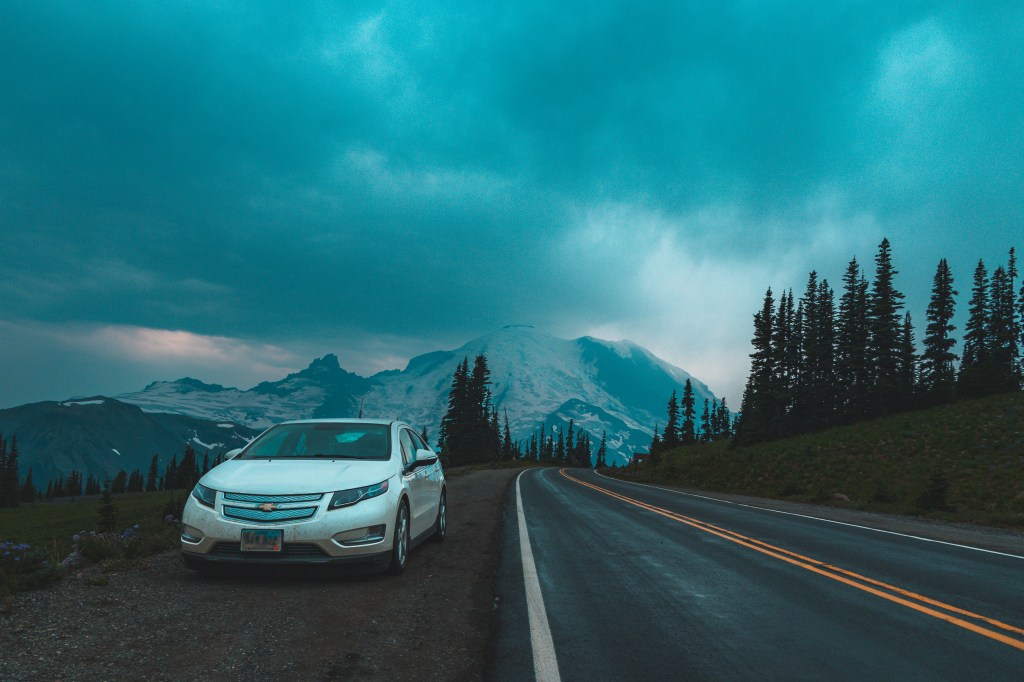
And off the beaten path was exactly where we wanted to go. We didn’t see everything on our list, but we did cover more than 11,000 miles in 12 Western states, visiting about two dozen national parks and other public lands over 11 weeks. A few of our destinations were fairly urban and developed, but we stuck to the backcountry as much as possible. We drove into lava fields at Craters of the Moon so we could hike five miles and camp in a dormant volcano cone. We wound our way up gravel roads on the side of Mount Saint Helens so we could summit the peak. We took logging roads in the Wyoming Range, we explored dusty tracks in the Sonoran Desert, and we found hidden views on cliffs above the Pacific on the California Coast.
Could we have done it all in a pure electric vehicle? Maybe – barely – but it would have taken a lot of careful planning. And while our trips were fairly well-organized, we left room for spontaneous exploring that would have been MUCH more difficult if we’d been worried about straying too far from an EV charger. Hell, we wound up in a few places that almost had me worried about being too far from a gas station. But gasoline is still king, especially in rural America. We couldn’t count on groceries in some of the places we stopped, but we could almost always find a gas pump. Traveling in the Volt gave us the freedom that comes with a traditional internal combustion car, along with a lot of the advantages of an electric vehicle.

So what was it like to take a weird plug-in hybrid on an epic adventure around the American West?
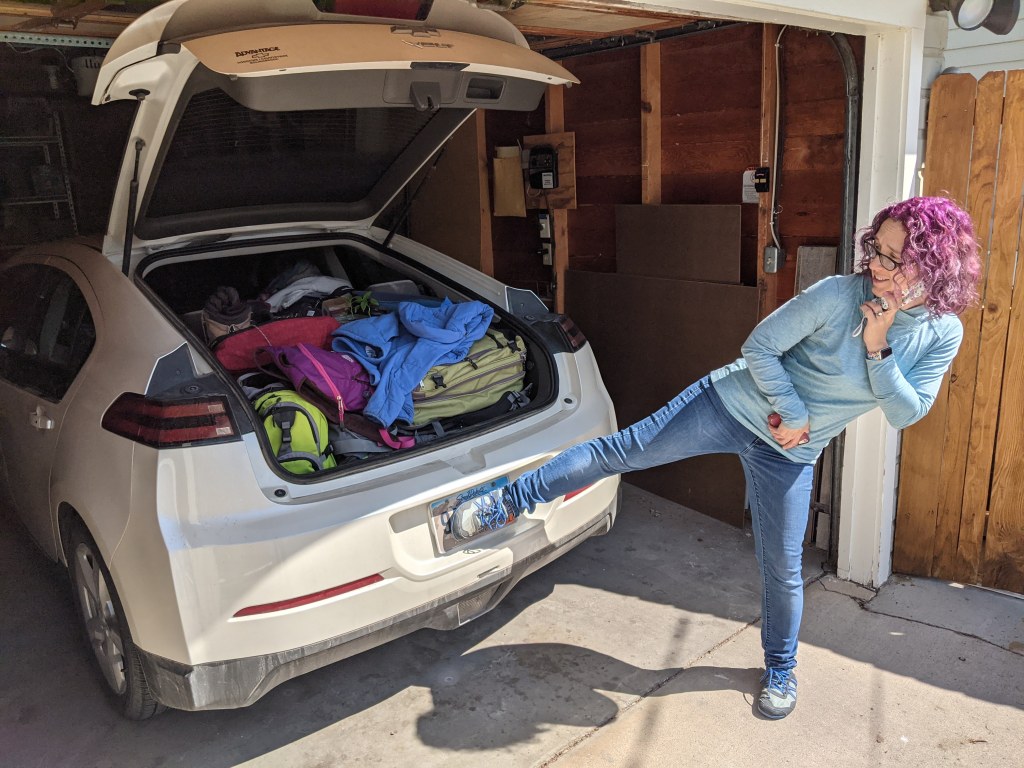
It was just big enough. The Chevy Volt isn’t a large car. It’s only got seating for four and 10.6 cubit feet of cargo space, which is modest for a hatchback sedan. Teeny, even. But thanks to some creative packing, we had enough room for everything we wanted. In addition to regular luggage, we managed to bring along a big cooler, all our backcountry equipment, my camera gear, a few boxes of vittles & miscellaneous provisions, and an Instant Pot.
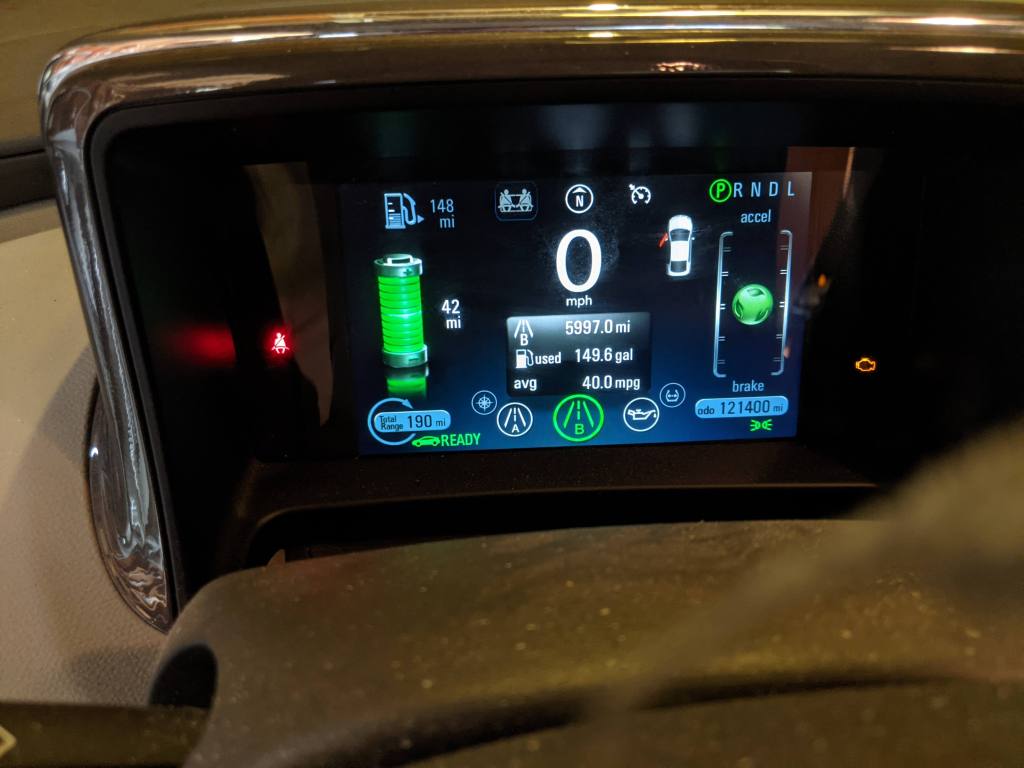
It was VERY inexpensive. We charged the car when we could, but that wasn’t often. That means we primarily relied on the gas engine, which averaged just a little more than 40 MPG over our collective 11,000 miles. Not as good as some new uber-efficient gas-powered cars, but still mighty fine. Just as significantly, the maintenance on this car has been practically nothing. In the past six years, I’ve changed the oil six times, replaced the headlamps and wipers once, and swapped the balding factory tires for some stickier all-seasons. That’s it. This is the cheapest car to own that I’ve ever had, and a couple massive road trips didn’t result in any unexpected issues.
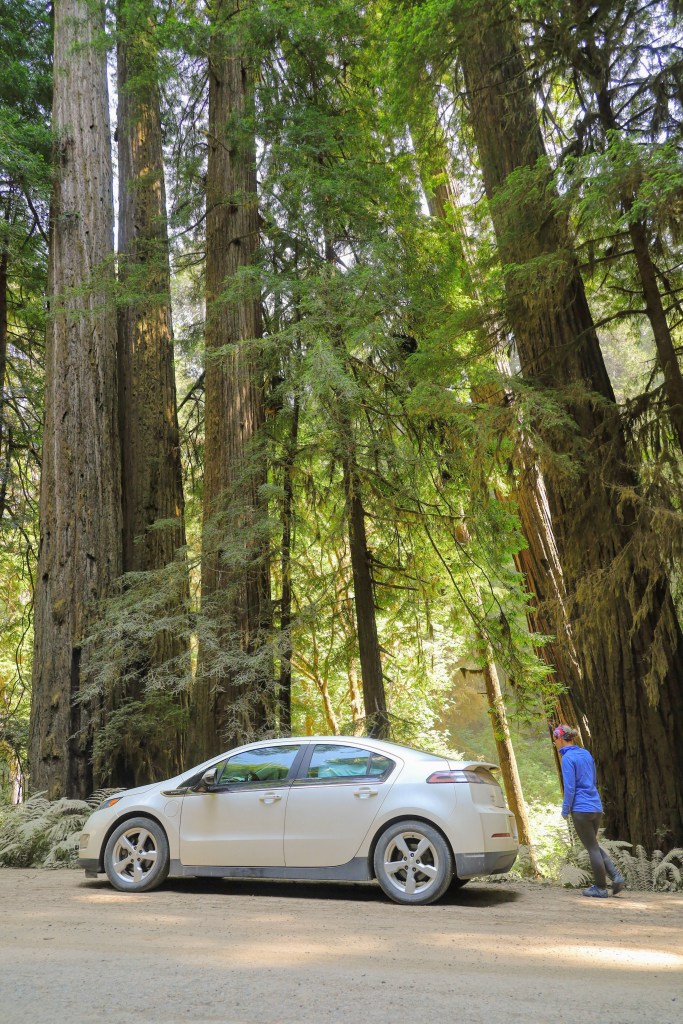
We could go everywhere we wanted to. (Almost.) The Volt is designed for efficiency, and the car sits very low to the ground to reduce drag. That’s fine for asphalt and concrete, but not so great for unpaved and uneven roads in the wildlands. But in practice, the low ground clearance wasn’t a problem: we took the car up gravel mountain roads, rocky tracks in the desert, and questionably-maintained dirt trails without issues. There was a deeply rutted county road near Scotts Bluff that got a little dodgy, but nothing that a little careful driving couldn’t handle. And the sudden spring snowsquall on Monarch Pass in Colorado quickly made the road pretty slick, but the Volt does surprisingly well on slippery roads with the right set of tires. (We easily climbed sections of road that pickups in four-wheel drive were struggling with.) The only place we couldn’t drive? The four-wheel-drive roads in Canyonlands National Park. But that wasn’t a Volt problem, of course – that was a car problem. Anything less than a high-clearance, low-range 4WD wouldn’t have cut it. (We’ll come back someday in a Jeep. Or maybe a Rivian R1T if we strike it rich.)

I wish the car had an inverter. One of the nifty parts about having an electric car is that you can tap that giant battery to power all kinds of gizmos, from lights to refrigerators to cooktops. Newer EVs like the Ford F-150 Lightning have built-in inverters and outlet panels for that sort of thing, but the Chevy Volt never had that option. It would have been handy for some of our front-country adventures. We could have cooked gourmet meals at camp! Had lights and fans in our tent! Kept laptops running for night-time blogging! Alas. But I recently discovered a Reddit post from a user who retrofitted their first-gen Volt with a 1,000-watt inverter and a very slick 3D-printed outlet panel, and then shared the files and directions with the rest of us nerds. Looks like I could replicate the whole project for about $250. Too late for our last trip, but I’m making plans for the next one.
This would not have been a good car choice for a family trip. It’s not nearly big enough for a significant road trip with more than two people. But for the pair of us, it was great. Would we have been more comfortable in something a bit larger? Hands down. We briefly considered borrowing an older CR-V from Laura’s parents, and I think that would have ticked a lot of our boxes: more space, greater ground clearance, and optional all-wheel drive are great things to have.

But as efficient as something like a CR-V is, it wouldn’t have gotten anything close to 40 MPG – and we would have paid for at least three oil changes. We changed the oil in the Volt once before we left, and the car’s built-in calculator showed that we had about 50% of that change’s useful life remaining after our return. We can easily go another 11,000 miles before we pay for another one – and probably more, since we mostly just run on battery power for trips around town. Taking the Volt was probably one of the least-expensive ways we could have done a massive road trip across half the country.
How much cheaper was it? All told, we used about 275 total gallons of gas. If we had taken a car that got 30 MPG instead of the 40 we got in the Volt, that would have meant an extra 91.6 gallons. Assuming an average cost of roughly $4 a gallon (which probably isn’t far off, given that we drove through some of the most expensive gasoline markets in the United States during peak summer season), that would have meant an extra $366. Paying for two or three more oil changes could have added another $100-ish to that bill. Not tons of money when you spread it out over 11 weeks on the road, but it’s not peanuts, either. It was enough to pay for our two-night stay at Phantom Ranch, or our one-night reservation at the Sperry Chalet.
We’re considering another road trip in the fall – this time to New England and then down the East Coast to Florida. We’ll probably pile everything into the Volt again. Someday I’m sure we’ll get something bigger, even more efficient, and just as easy to take wherever we want to go. Until then, the ‘ol Volt will do just fine.
 Thither & Yon
Thank you for this. I have been kinda obsessed with the Volt since it was released but haven’t been able to purchase one due to life getting in the way. I have been looking at older first generation Volts for a while. The fact that you have over 100,000 miles on yours just makes me want one more. I know that an electric drive propulsion generally has less issues than a gasoline one. Most Volts I look at that are in my price range have about 60,000-80,000 miles on them. I was worried about maintenance and reliability issues. Your post is very informative and a nice read. Once I’m able to I’m going to get a Volt. I can only dream about an 11,000 mile road trip though. Just not feasible for me. But a few shorter ones will do just fine. I hotter you and your wife are well. Thank you again for the post. DJ
LikeLike
We have two Volts, a 2013 and a 2019. Being retired in Utah, we seldom buy gas. 99% of our daily is just a few miles. But when I make a 180 mile trip to my remote Wyoming property, the gas engine works… At 45 MPG.
LikeLike
I have a 2015 Volt and I absolutely love it. But I did try to take it on a road into the Duckabush trail in the Olympics and had to turn around. Since it is so low to the ground it started to scrape bottom on the rocky un-maintained road, so turned around and drove home.
LikeLike
Funny you mention that: We took our Volt out with some friends to find an old ghost town here in the Black Hills. Turns out the gravel Forest Service road got a little more, uh, “rustic” than I expected in the higher elevations. We nearly turned around four times, but every time I found a way through. Of course, that required doing things like building a path over some deep ruts with rocks and fill, but hey, we made it! Nary a ding on the undercarriage. Totally worth the looks on the faces of those guys in the Jeep at the ghost town.
Still, I probably won’t do that again.
LikeLike