“How did you sleep?” Gideon asked, a ritual morning check-in.
“Not very much,” I grumbled as I bumbled around making my second cup of morning tea.
“How many hours, do you think?” he asked.
“Five?” I hazarded, then confirmed my guess with my watch’s sleep tracker. “Five hours and seventeen minutes.”
“That’s okay,” Gideon said, and I realized he’d been sizing up the likelihood that I would collapse halfway through today’s hike. Apparently five hours passes muster. “It’s harder to sleep at altitude,” he added reassuringly.
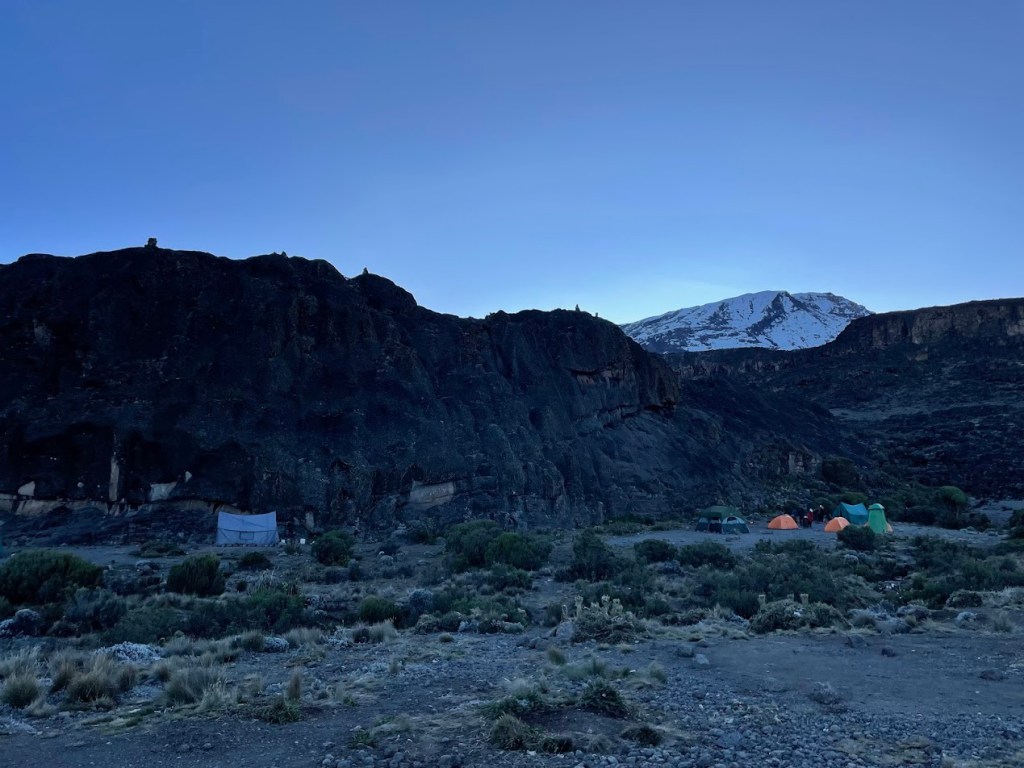
In fact, I did not blame the altitude. I’m coming to realize I have some magical acclimatization gene that allows me to become comfortable at high elevations much faster than most. What I blamed was the hot tea I’d been drinking at lunch. At home, I drink no caffeine. Like, not any. No soda, no coffee, and only caffeine-free tea. I can get away with one (large) cup of real black tea first thing in the morning if I drink it more than 15 hours before bedtime. I’ve done the research. I know this about myself.
Hot tea in a cold tent at lunchtime had just seemed like such a good idea for the last three days. Surely all the calories burned during the hiking should burn off the extra caffeine too…? No…?
No. Caffeine does not work that way. The lunchtime tea would have to go, but I was not yet willing to give up on my two cups in the morning.
I munched my way crankily but successfully through my veggie omelette and toast with sausage while Dustin and Nyla respectfully pretended I didn’t exist and made half-hearted efforts to eat their oatmeal.
Today’s agenda was a doozie: From our camp at 13,400 feet, we would climb to 15,200 for lunch, then come back down to 13,000 feet to sleep for the night. This is the healthy way to help a body acclimatized to high elevations. It’s also a pretty extreme hike for those who don’t regularly trot up and down high mountains.
“Pole pole,” Niko reminded everyone as we made our way out of camp just after 8am.
We trudged up the hill plenty pole, as I stopped every few minutes to take yet another photo of the ice needles that had sprouted up all around us during the night. I could not get over how cool they were.
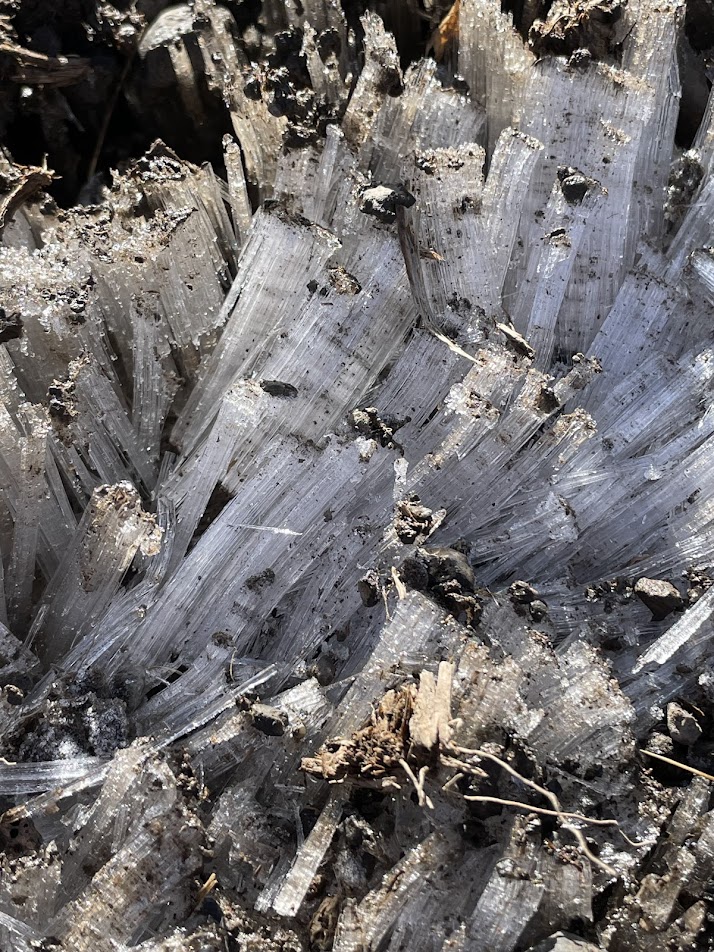
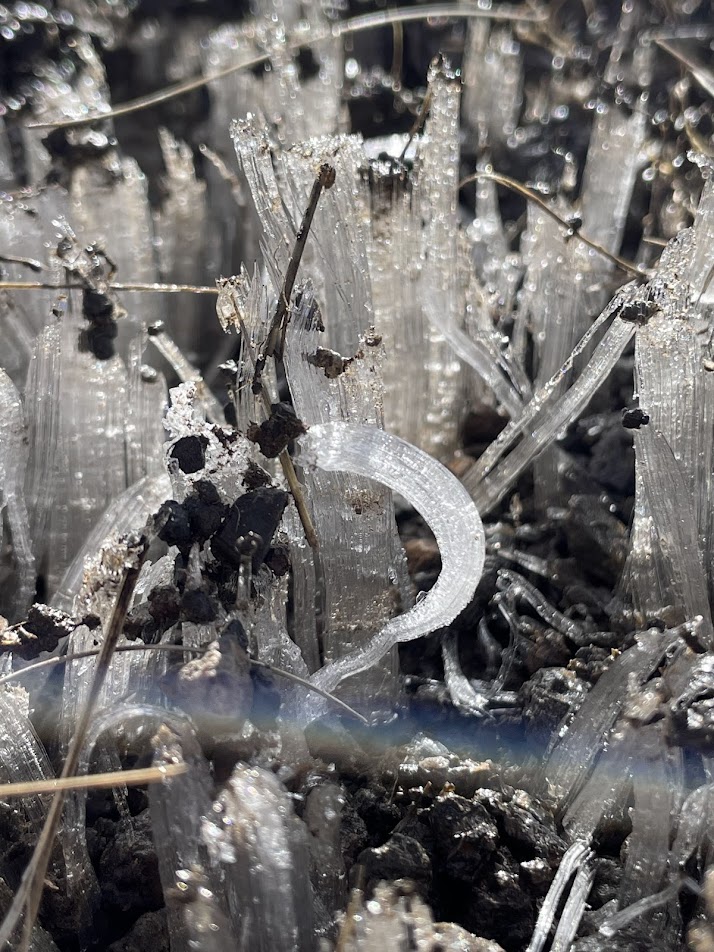
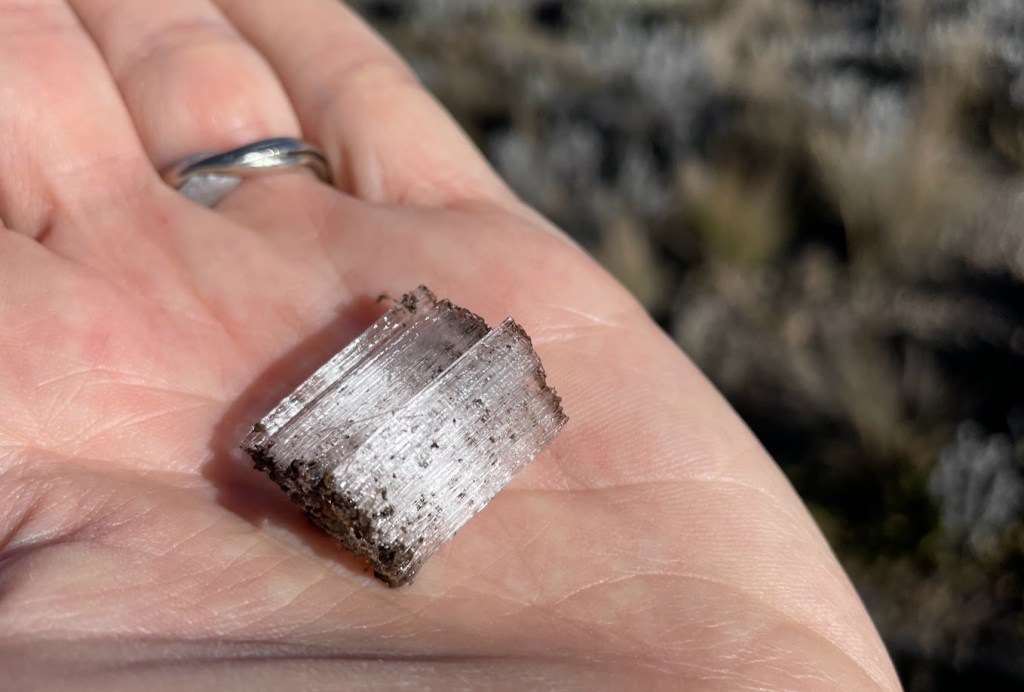
Ice needles form when the air is below freezing and the wet ground is above freezing. The water at the very surface freezes, pulling toward the colder air. This brings up more water which then freezes, pulling up, until tiny little columns of ice stand an inch or more above the ground, usually wearing crumbs of soil as hats. It’s SO COOL. (As a side note, it’s also infinitely satisfying to step on and there’s so much of it you can’t even feel bad.)
As I stood up from a round of ice photos about twenty minutes into the hike, we heard our first rescue helicopter of the trip chopping its way up the valley. We all turned to watch as it glided over a camp that was mostly broken down, and landed by one last cluster of tents.

“The woman had a blood oxygen of 25 this morning,” Gideon said. He and his pulse oximeter had been summoned away for verification during our breakfast when the woman woke up in bad shape. “She should have turned around at the last camp, but she refused. This is what happens.”
We resumed our hike, reflecting on our own blood oxygen levels and the possibility of actually needing the helicopter rescue insurance we’d paid for. Fortunately, we’ve all been clocking nightly O2 readings comfortably in the green zone.
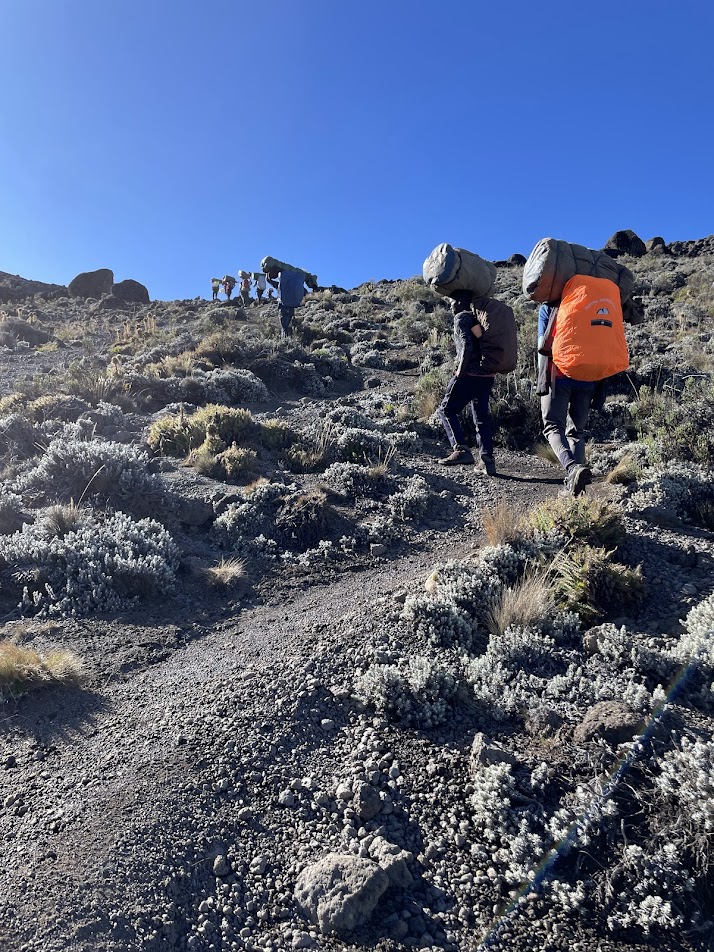
“Fourteen thousand feet!” I announced after 45 minutes of steady incline.
“Fourteen thousand feet!” cheered our little crew. Gideon knows the elevations of all our stops in both meters and feet, which is really going above and beyond for his American clients. No one else in the world cares about feet. I try so hard to think in meters, but meters just don’t mean as much to me as feet.
“Mama Simba! You’ve just reached the highest elevation of your life!” I announced around the two-hour mark. We’d reached 14,500 feet, firmly beating Nyla’s previous record from the top of Pikes’s Peak in Colorado. “In fact,” I added, “we’ve just hiked off the top of the entire continental United States.” California’s Mount Whitney is only 14,494 feet tall.
Nyla’s cheer this time was somewhat halfhearted. We may have finally reached the point where her drive to give 100% came even with the effort that declining oxygen would permit.
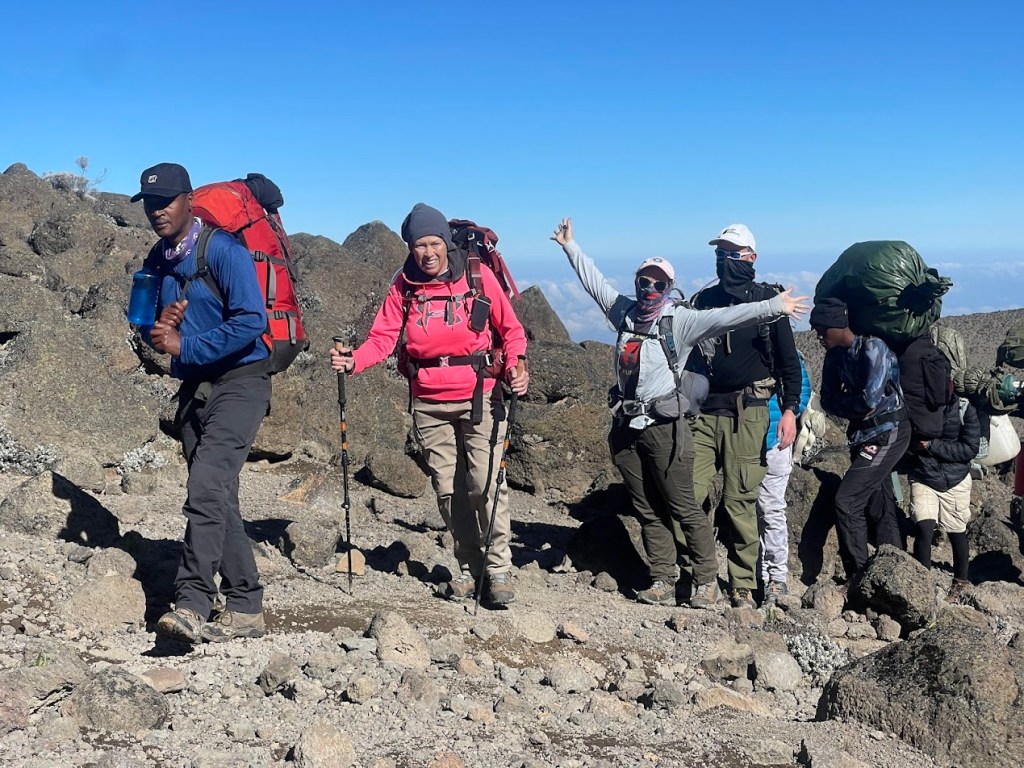
Shortly after, we took a ten-minute pause to regroup before tackling the final 500 feet.
“Sippy sip!” we helpfully reminded Nyla.
“I’m drinking, I’m drinking!” she protested, but took another sip anyway.
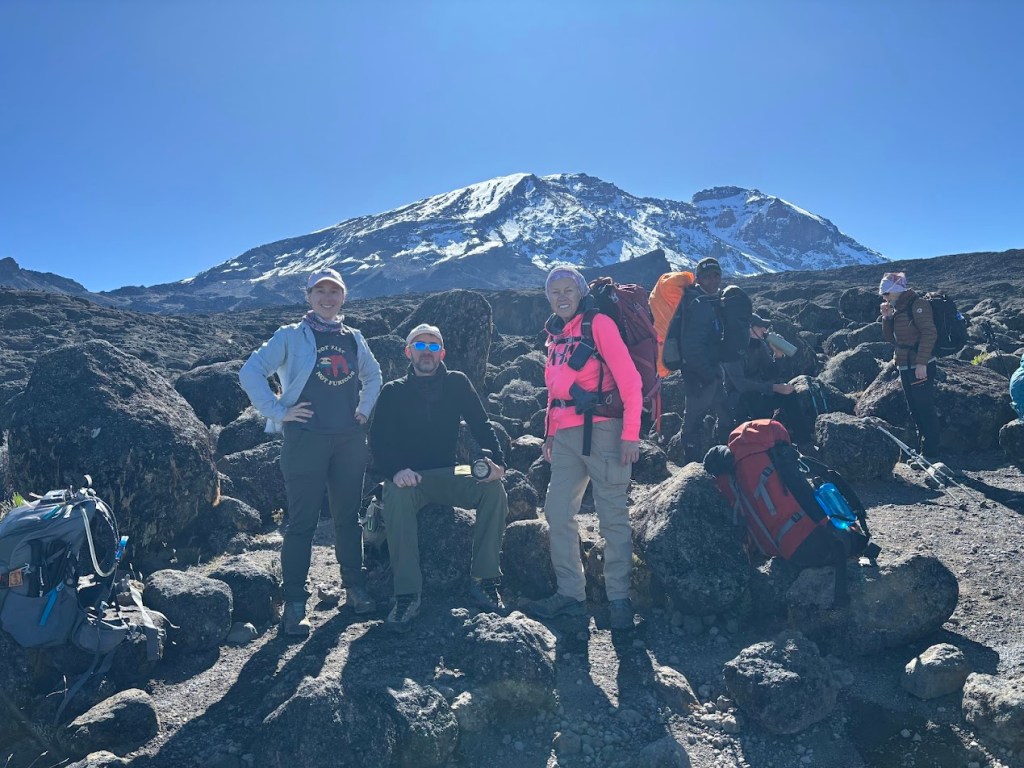
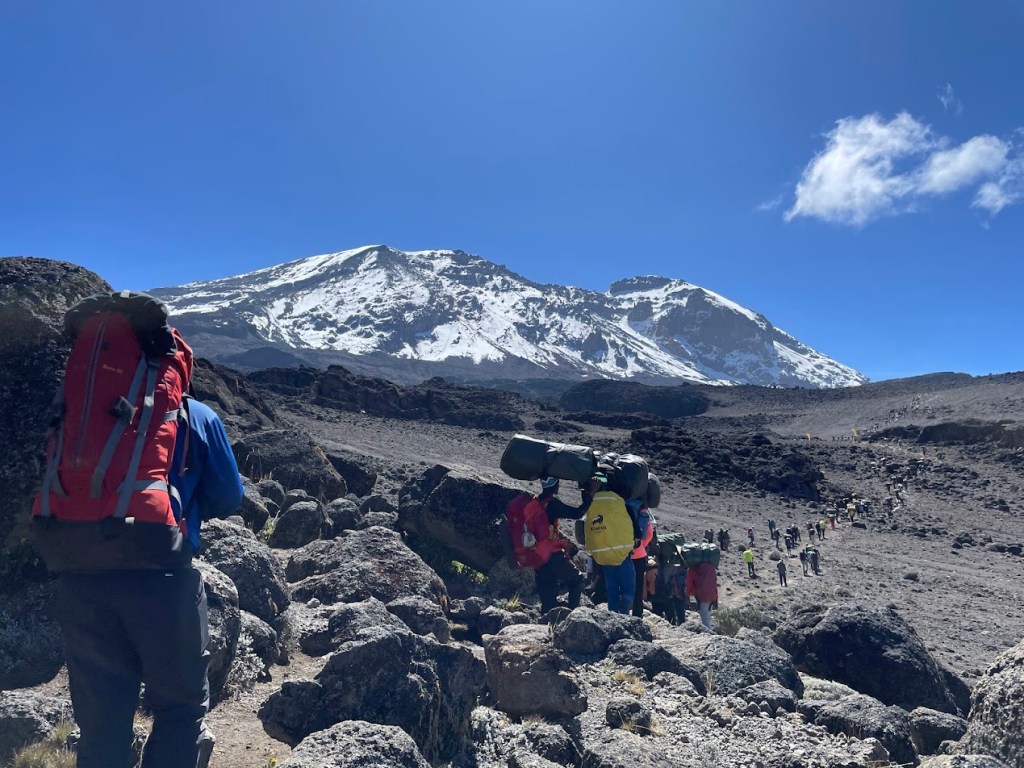
“Fifteen thousand feet!” I called an hour later. “We’ve reached the top of Meru!”
No one had much enthusiasm for my announcement this time. You could practically see everyone dreaming of taking a nice, long sitting break and getting this unpleasant excursion over with.
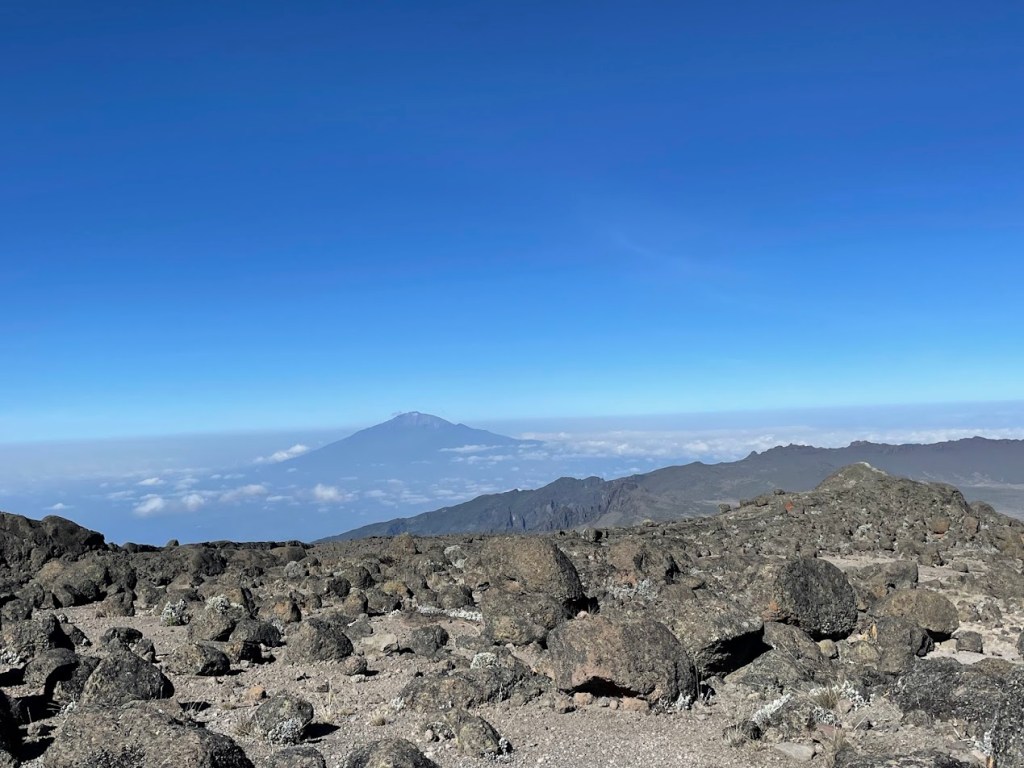
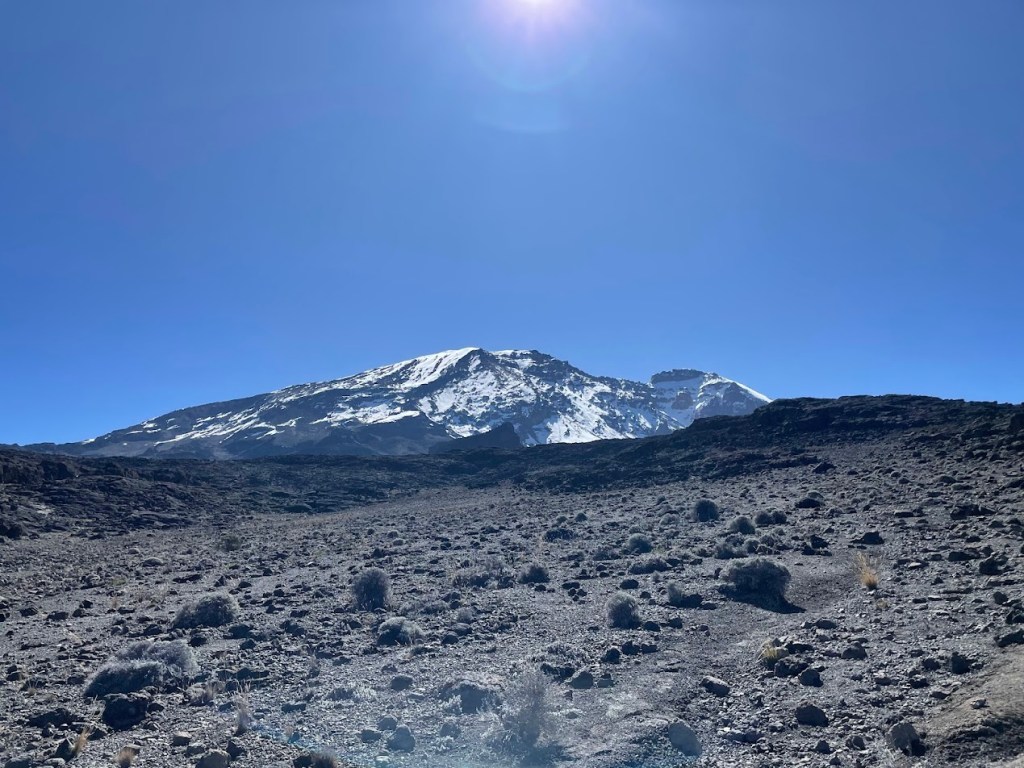
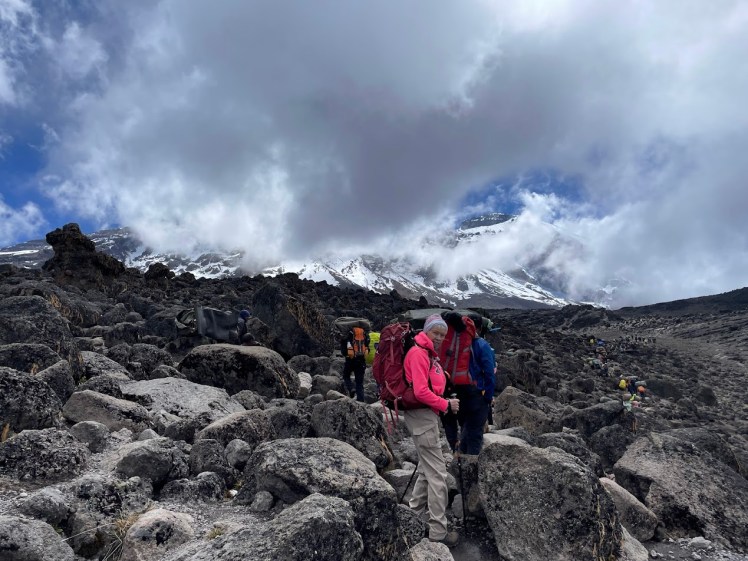
Our lunch destination was Lava Tower Camp, which many groups use for acclimatization, as we were. Only a few use it as an overnight camp, since sleeping at this elevation after too few days is a recipe for altitude sickness.
The eponymous lava tower came into view a good hour before we reached it, appearing and disappearing behind cottony clouds.
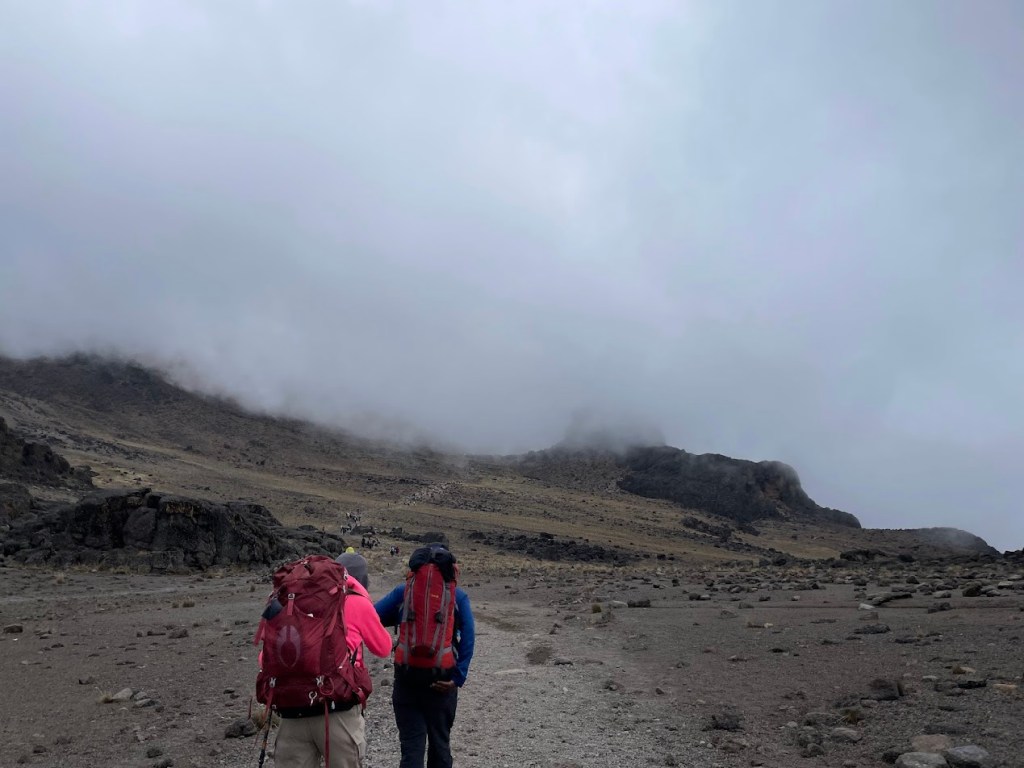
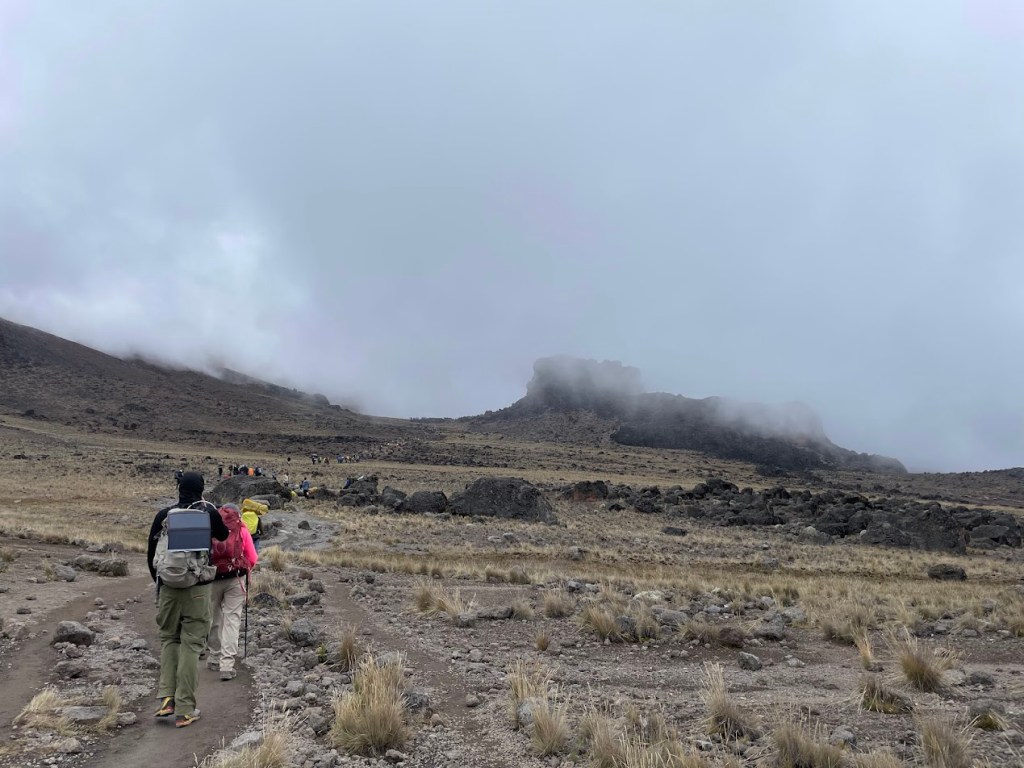
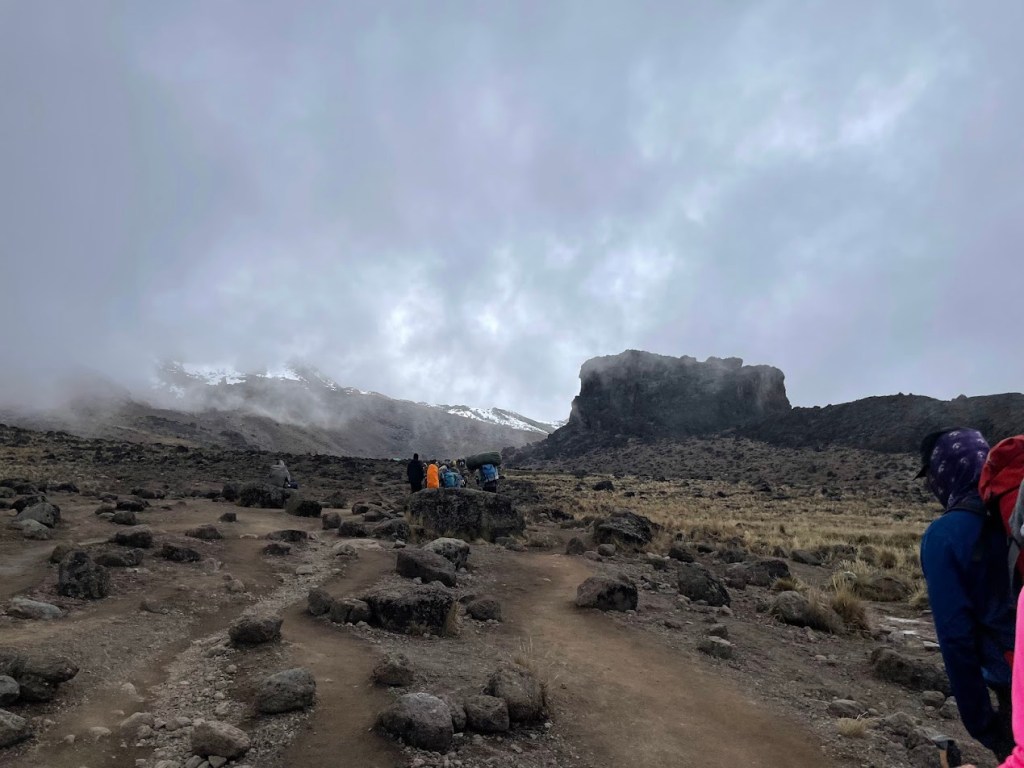
“Yay,” we all muttered with maximum enthusiasm as we crested the final rise and came in among the tents.
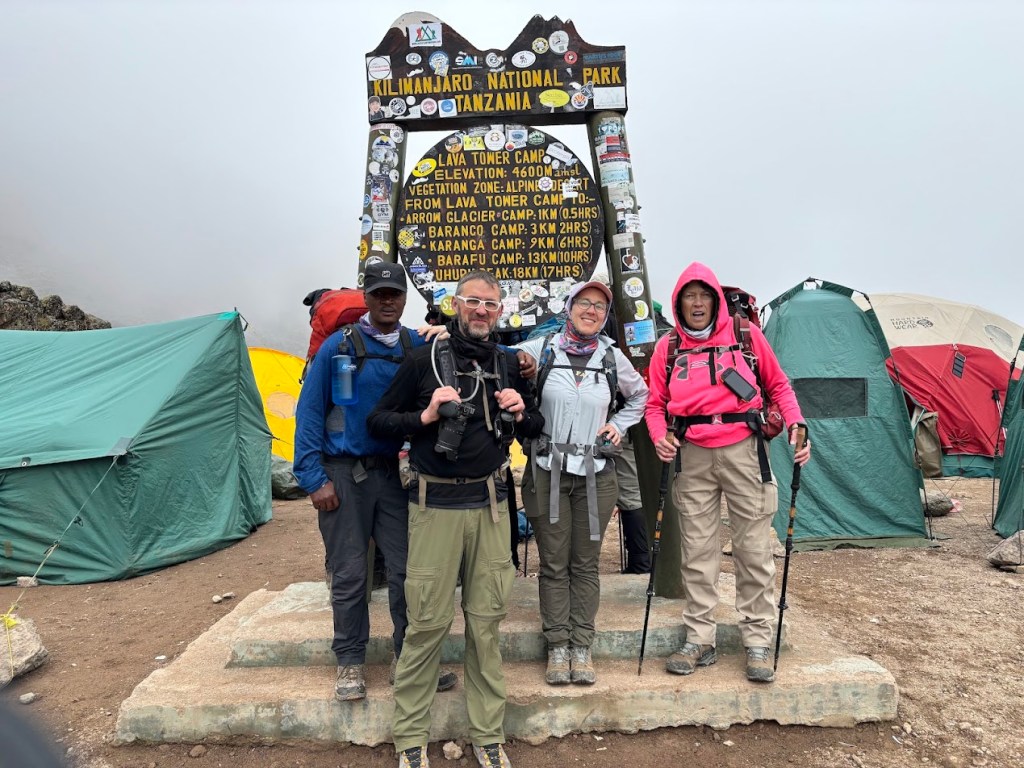
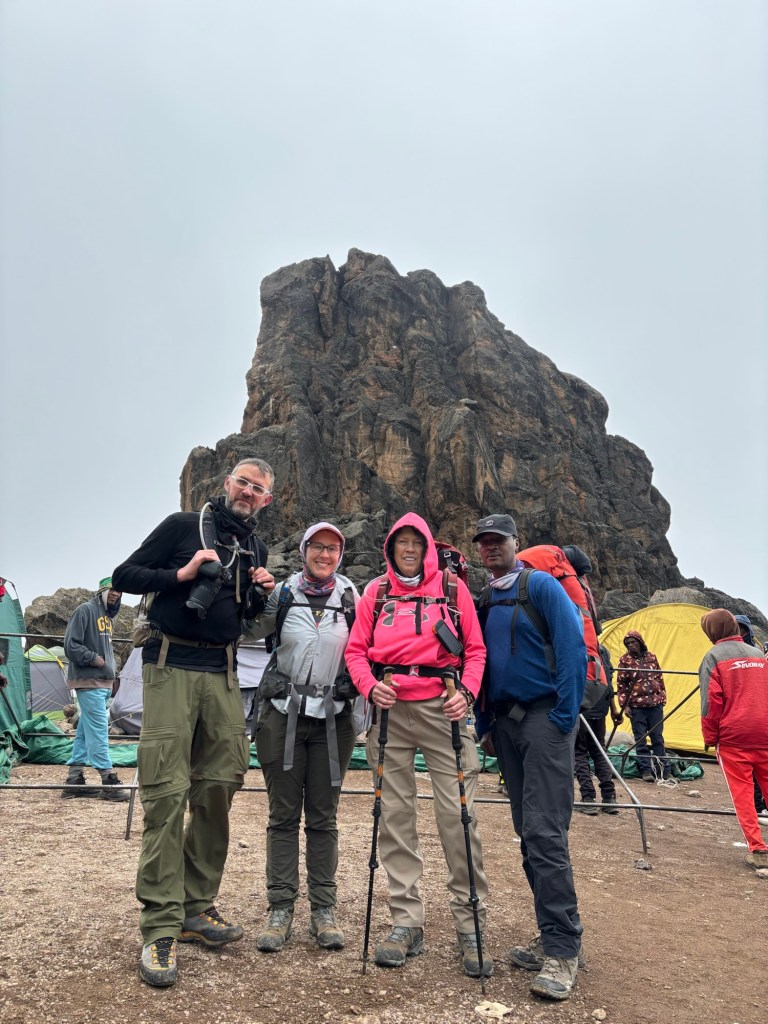
“It’s kind of mean to make us eat at 15,000 feet,” Dustin noted as we arranged ourselves in the dining tent. I could see that he and Nyla had no interest in their meals whatsoever. Even I felt unusually indifferent to the corn chowder and veggie fritters on the menu, but I still managed to eat a very healthy share. Dustin made a valiant effort with his, but Mama Simba was so tired, she even gave up on apologizing about not wanting the food.
“I can’t, I can’t,” she said, covering her plate with her hands.
“Awww,” Mandela said mournfully. “Just take a little.” But even he could tell that taking it didn’t mean she would eat it today.
It’s a testament to my tiredness that I failed to take a picture of any of today’s meals.
“Make sure you keep your rain gear handy,” Gideon said. The clouds that had been playing hide-and-seek with the lava tower looked a bit juicier on the downhill side of the slope.
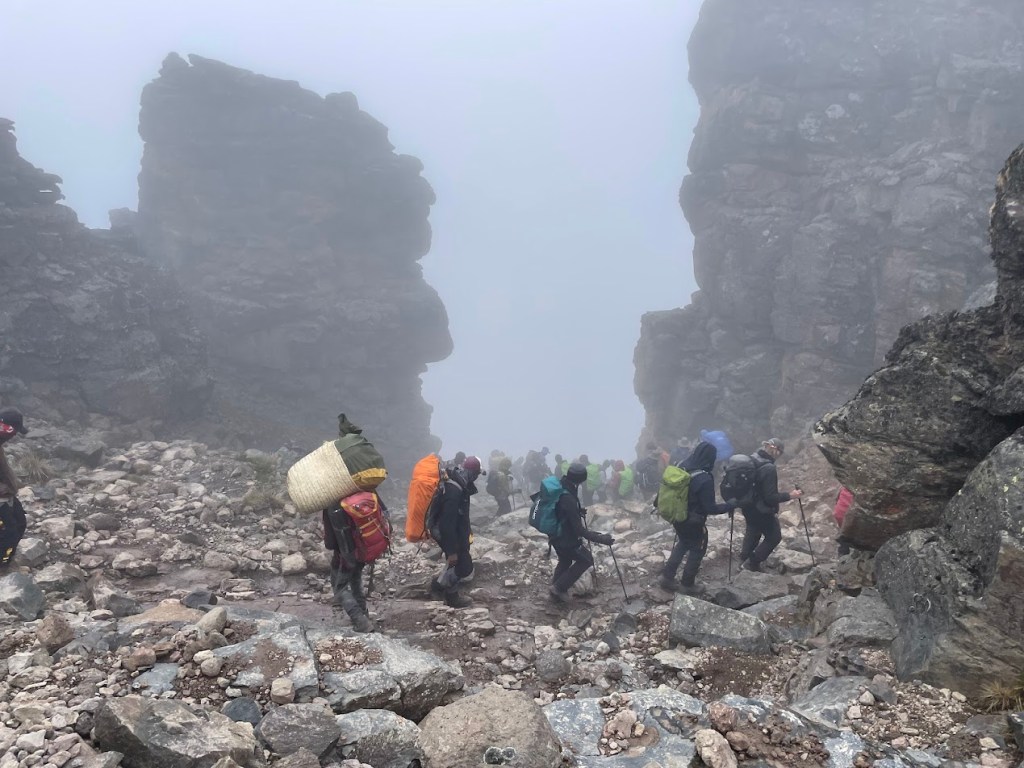
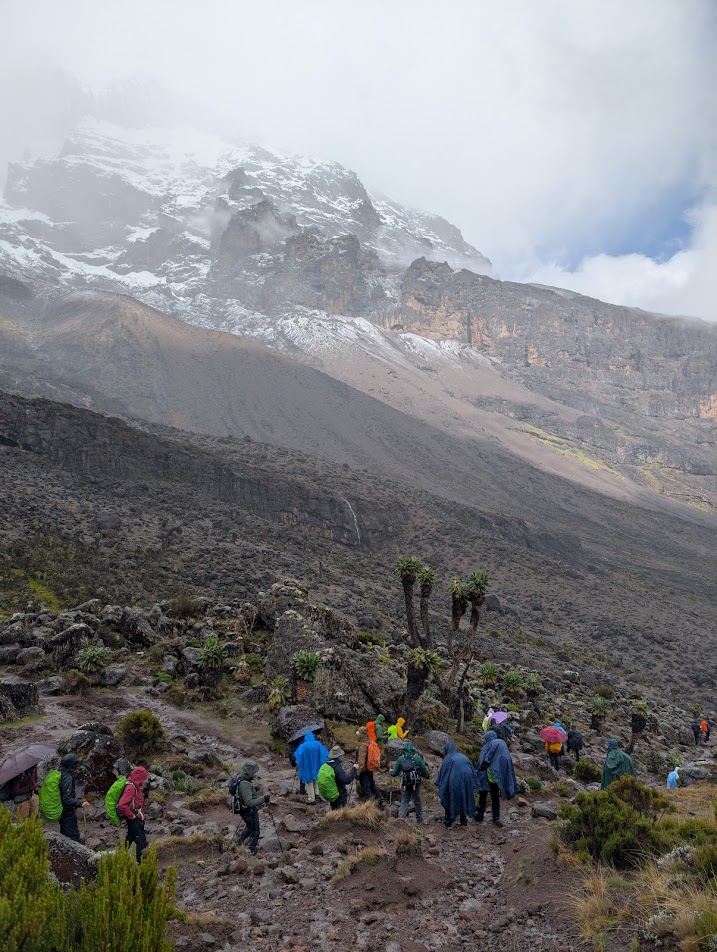
In fact, we only made it about 30 minutes into the hike before we had to pull over and pull on rain coats and pants. The rain was, admittedly, a bit crunchy and bouncy at this point, but seemed likely to persist.
Another 500 feet down it got less crunchy.
“Ponchos!” Gideon commanded, and we stopped again to pull on yet another layer of rain gear.
It’s hard to convey how miserable it is to hike with a bulky pack under full rain gear in steady, cold rain while going steeply downhill over loose stones. This is basically the recipe for misery in its purest form.
I am normally an advocate for hiking each day’s hike one step at a time – that is, for not counting down the miles or feet of elevation because that won’t get you there any faster – but it was nearly impossible today. I kept checking my watch’s altimeter, wishing the feet would disappear faster. Gideon had predicted the afternoon’s hike would take two hours, but with one hour gone I had a sinking feeling we weren’t halfway there yet.
The rain wasn’t drenching, but it was relentless. Step, step, step forever, placing your feet so carefully, but trying to go as quick as you can to just get this over with. No photos from this rotten stretch, because taking photos is a recipe for getting more wet and being more unhappy.
A peel of thunder rolled. I began plotting a disaster movie in my head. A slow hiker causing a bottleneck over a creek crossing. A bolt of lightning loosening a dam of rocks that was overflowing anyway. Dozens of tourists washed off the mountain by a shocking mud and rockslide.
Look, I never said it was a good movie.
At one point, Nyla lost her footing. I was close enough behind that I grabbed her elbow just as she caught herself with her hiking pole.
“You okay?” I asked when she was steady.
“I’m fine, I’m fine,” she said. I’m convinced she would say that while being eaten alive by rabid monkeys, though, so I didn’t believe her.
Less than two minutes later, she slipped again, this time to be caught by Niko.
“My legs are rubber,” she groaned as she took a more solid minute to rebalance herself.
“Pole pole,” Niko said. I swear it’s the only time in my life I’ve ever seen Nyla think about doing bodily harm to another person.
“We’ve just got to get out of this,” she replied, and marched onward.
Weird trees started appearing as we made our way out of the Alpine Desert back into the Moorlands. We were on a different slope now, and the vegetation here looked very different here than it had on the northern slopes. This felt like a decidedly encouraging sign, but Mama Simba was not in a mood to be encouraged.
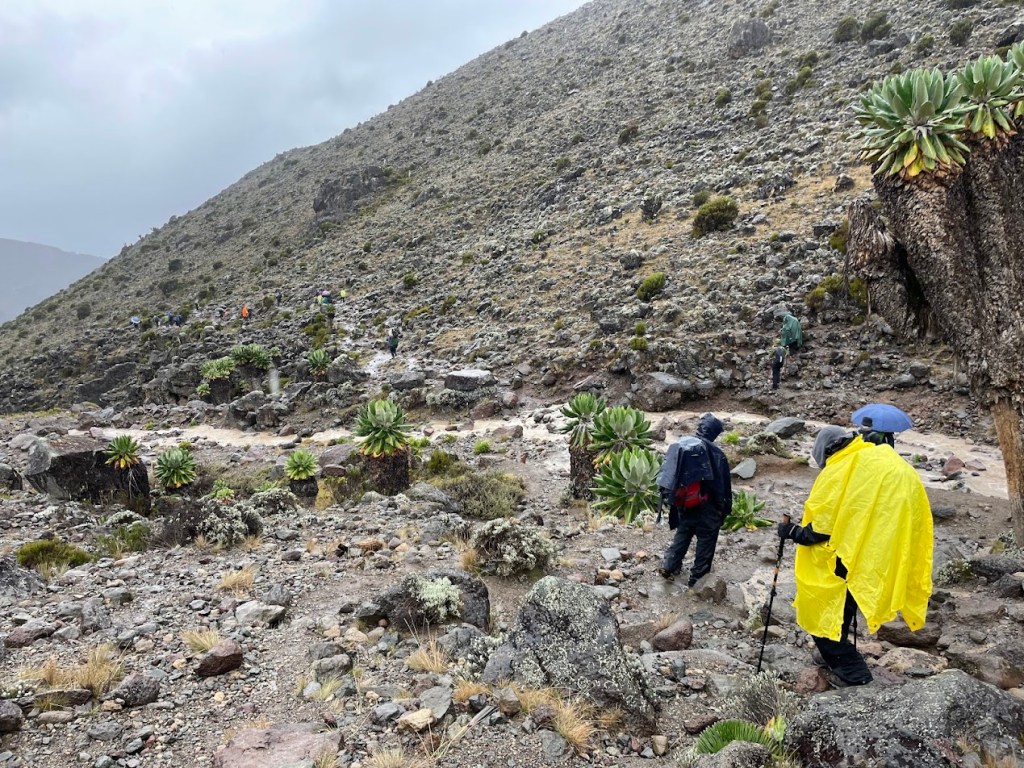
“I have to get out of this thing!” she said of her enormous yellow poncho. “I can’t see! I’m cooking in here! It’s not raining anymore anyway!”
“Yes it is,” Dustin said. “You need to keep it on.”
If your gear gets wet at these altitudes in this climate, it doesn’t get dry again. You can’t go to the summit with wet gear. That’s a literally life-threatening proposition.
Nyla let out a feral cat shriek and continued stomping down the mounted in the hated poncho.
Half an hour later we pulled off on a shrubby knoll.
“It’s not raining now,” Nyla said. Dustin opened his mouth but she cut him off. “No – I don’t care – I can’t wear this anymore.” The implication was clear: if staying in the poncho was her only route to the summit, she was not going to the summit. The poncho had to go.
Niko helped her out of it, then everyone took a turn to have our first bush wee of the descent, almost two hours after starting down the hill. Even I had not been drinking enough during the wretched rain, and a fantastic headache had begun pounding in a single square inch of my skull. I forced myself to take a good drink.
Dustin took the last wee break. Gideon, seeing that Nyla was ready to go, waved us on. “I’ll wait,” he said. “You keep going.” Niko, Nyla, and I trudged onward.
We didn’t see Dustin and Gideon again for what felt like ages, and when we did they blazed past us at full speed, not stopping to say “hi” or “how are you” or tell us where they were going.
Uh oh. Was Dustin sick? Had something serious happened behind the bush and Gideon was rushing him down to thicker oxygen? Would this soggy, unpleasant day bring us all to our knees?
As the clouds coiled thickly around us and the rain really did start to let up, my need to take moody pictures and collect new plants returned. If Dustin was dying, he must not be doing it too quickly, since he’d still been on his own two feet. Even Mama Simba could not remain perfectly cross in the presence of such oddities.
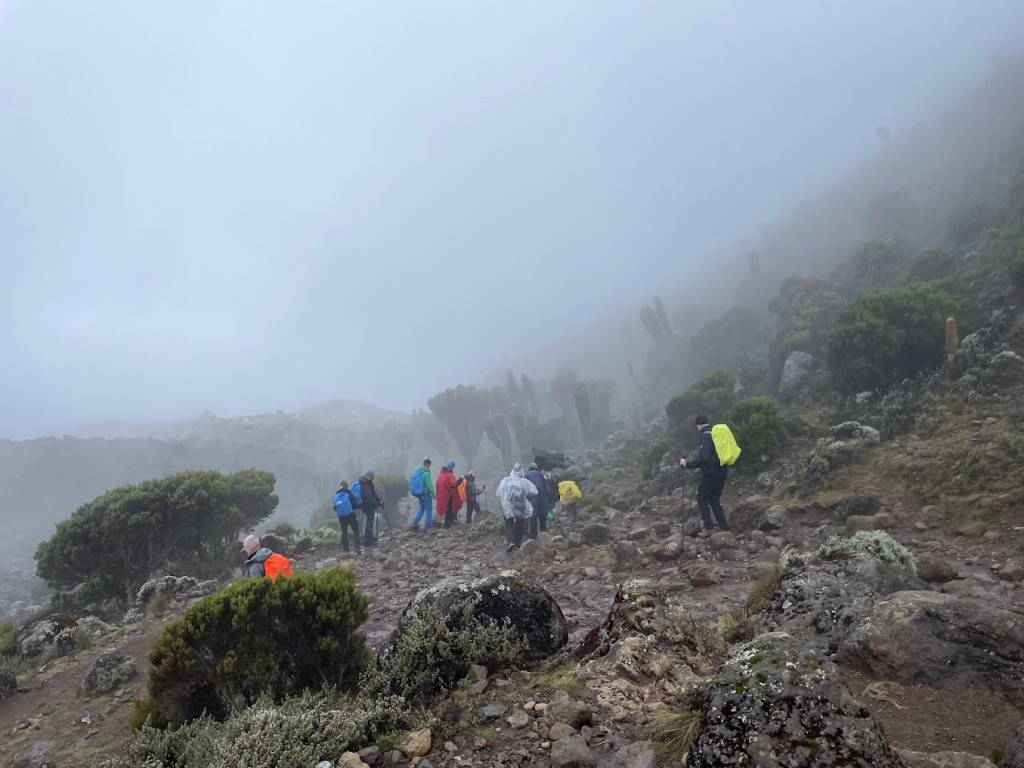
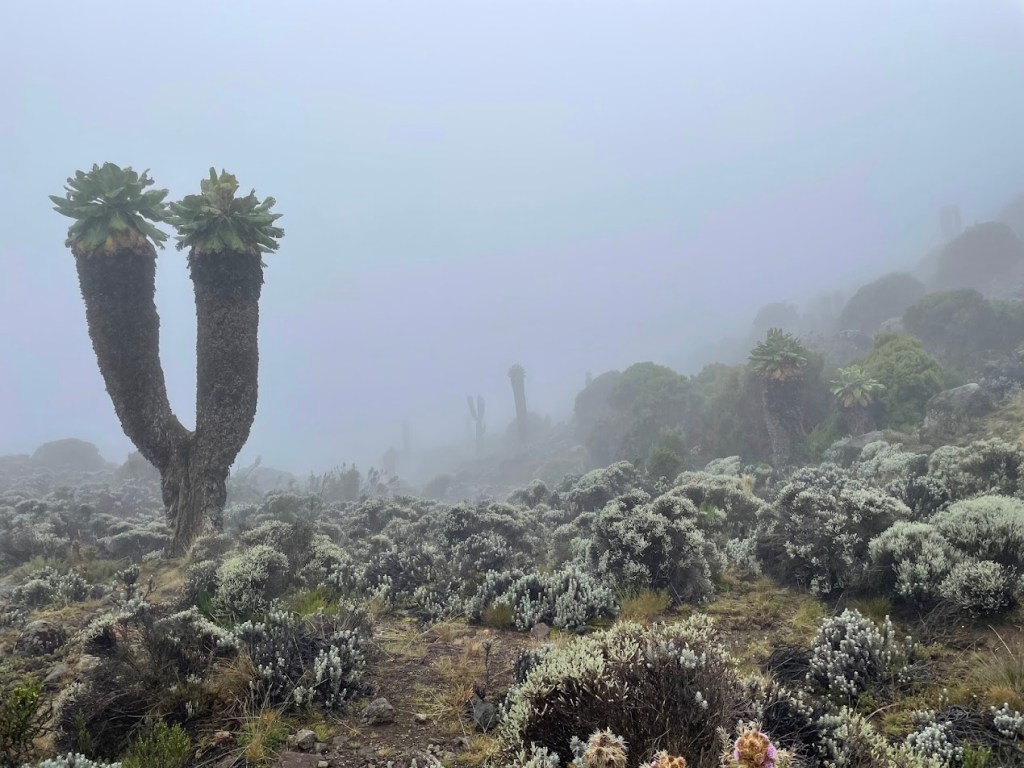
Tents started appearing out of the mists, and we all groaned in relief. Niko led us between around and through and among them for what seemed like ages.
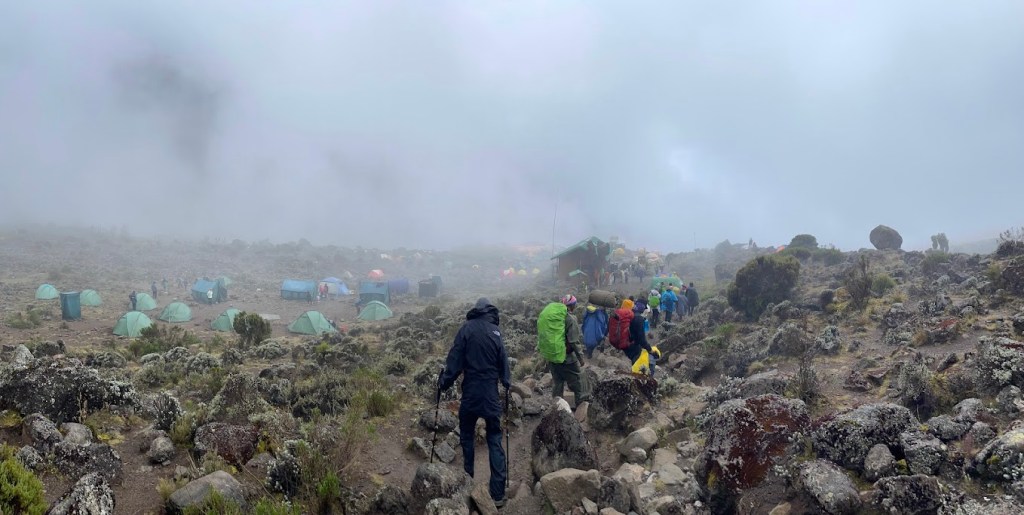
Dustin and Gideon reappeared through the mists. Turns out everyone was healthy, they had just forged ahead to sign us in with the National Park Service so we didn’t have to wait to find our tents.

The rain really had stopped as we arrived among our tents. Our camp crew greeted us with high-fives and applause. Everyone could see how battered and tattered the day had left us, and wanted to provide as much encouragement as possible.
Remaining ponchos were peeled off and hung from tree branches. Raincoats were draped over chairs in the dining tent. Soggy boots were pried off to reveal blessedly dry socks. Fuzzy pants were donned. Dustin discovered his bedding had gotten wet and set about finding ways to dry it out. (Hang it in the cooking tent!)
I wandered off to try and get some photos of our shockingly beautiful campsite. Baranco Camp is set up on the middle point of a W-shaped valley, with steep drop-offs on either side of the camp and steep slopes shooting up from the valley floors to another thousand feet above us. (I changed the whole font of this paragraph so the W would be the right shape.)
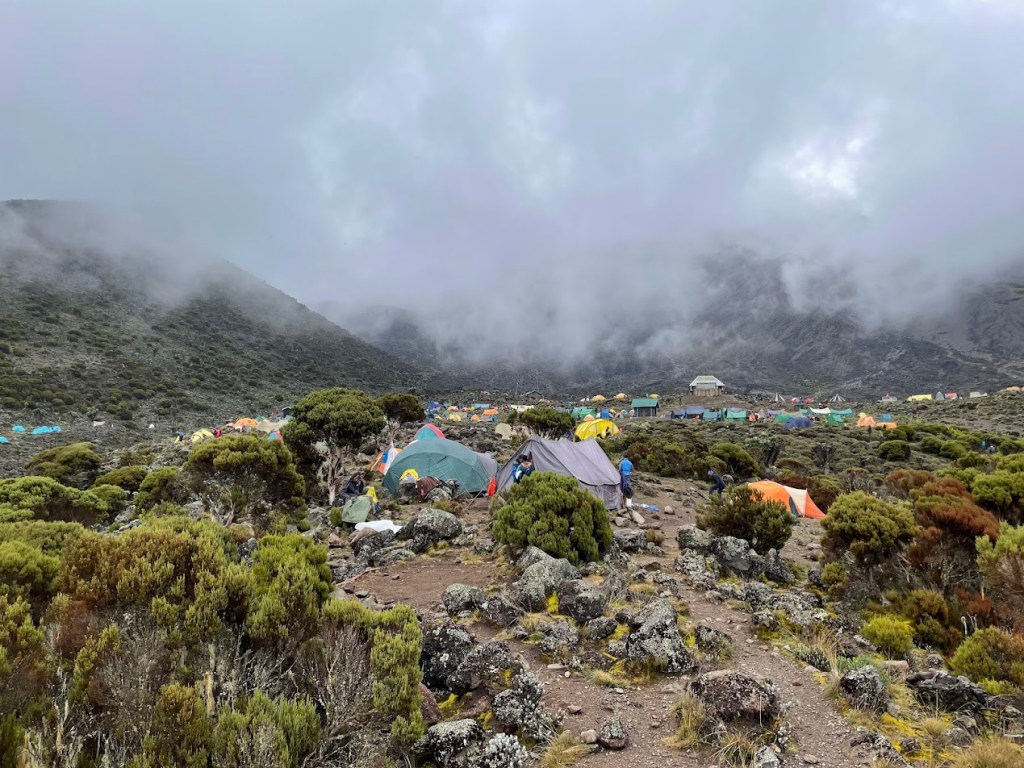
Our crew had set us up on the finger of land that stretched out between the two valleys. I followed the finger out and out, occasionally bumping into groups of porters who were also enjoying scenic breaks. “A little farther!” they kept shouting to me. “Best views!”
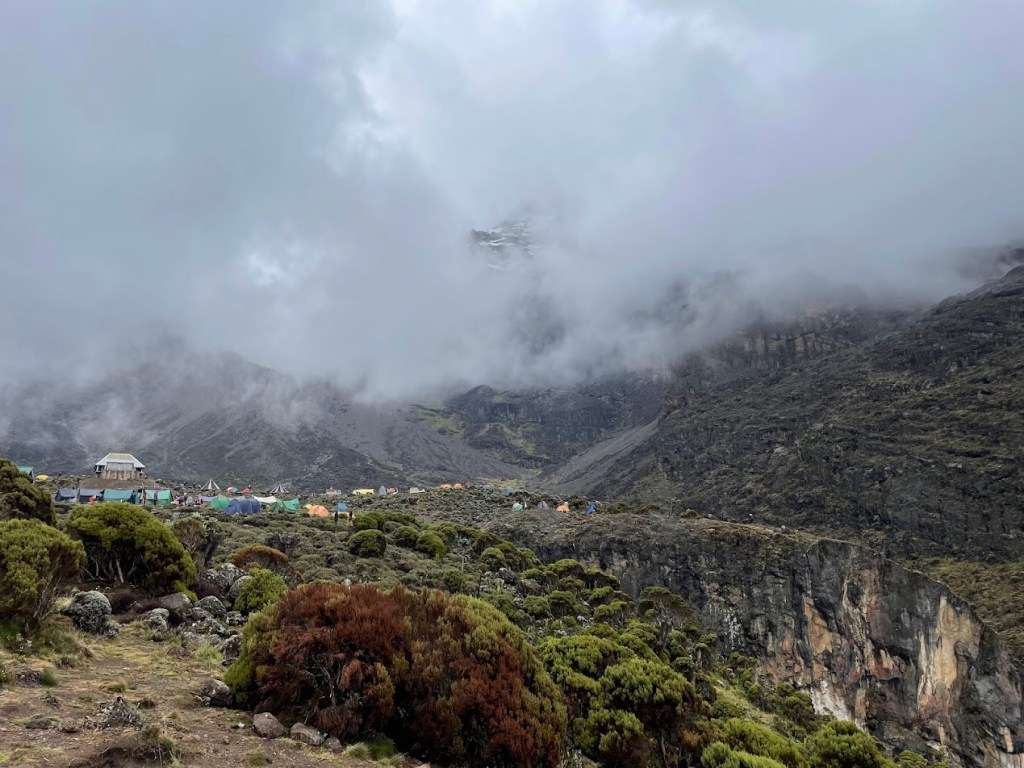
I went back to camp and pulled a chair out of the dining tent so I could sit and watch the views until dinnertime. Down below 13,000 feet again, it wasn’t even terribly cold.
I think Gideon would have waited until after eating to debrief and consider future plans, but Mama Simba wasn’t having it.
“Today was terrible,” she announced after declaring her bowl of tomato ginger soup too spicy and handing it to me. “I couldn’t see, I couldn’t breathe, I thought I would get strangled by that poncho-“
“And you didn’t drink enough,” Gideon put in.
“What will tomorrow’s hike be like? Will it be easier?” she asked, ignoring him.
I understood why she asked. After today, one might think a harder hike couldn’t be possible, but I knew better. I remembered how many thousands of vertical feet we still had in front of us. (Six. More than six thousand.)
Gideon made a pained face. “Tomorrow will be… okay, look outside. You see that wall of the rock? Tomorrow we start by climbing up that. Straight up. And then it will be up and down, but… it is challenging. And summit day will be tough. Today was a little tough, but summit day will be one of the toughest things you’ve ever done.”
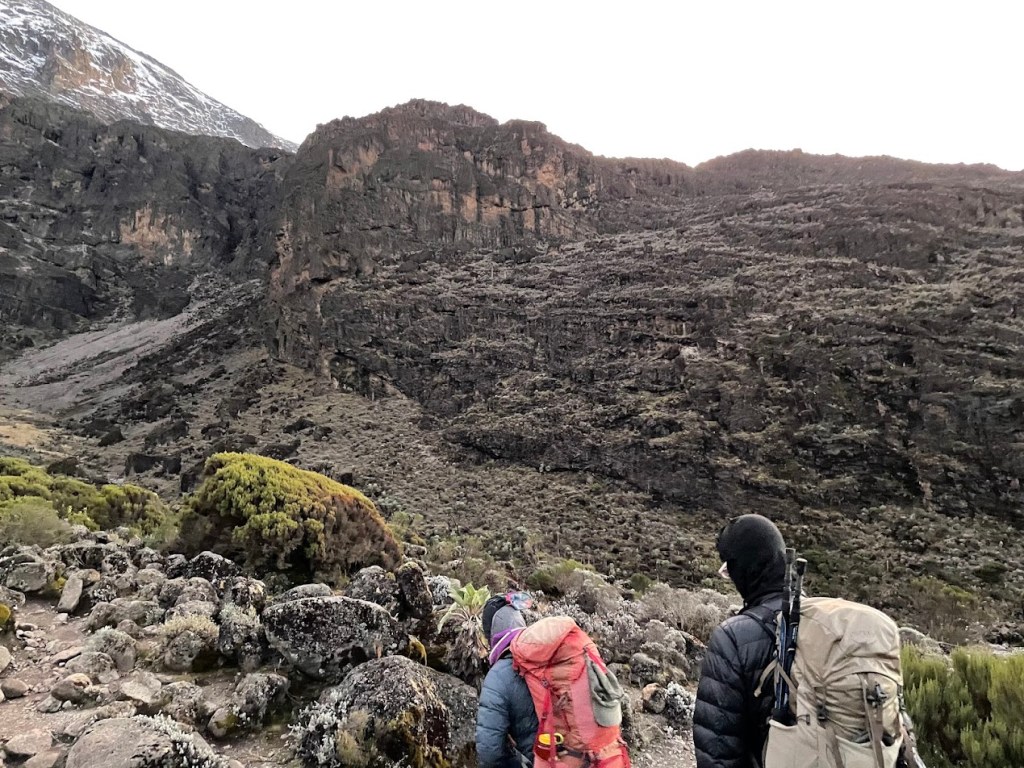
I watched Nyla’s wheels spinning as she tried to compute something even worse than today.
“We have some options,” Gideon continued. “Tomorrow, we are supposed to go as far as Karanga Camp, up the wall, then down, then back up. About four hours. The day after, we will continue to Barafu basecamp, another four hours.”
“How high is basecamp?” I asked.
“Fifteen thousand,” he said. “A little more. Fifteen-four. It can be a difficult to place to sleep. From there we will start hiking at midnight to reach the summit by sunrise, then we will come down to basecamp for a break, and keep going down from there to sleep at ten thousand feet. This will take about 16 hours.”
“But there’s a different option?” Dustin said.
“Your oxygen levels are good. We could consider skipping Karanga Camp and going straight to Barafu tomorrow. It would be four hours of hiking in the morning, and four more in the afternoon. If we do this, we can start for the summit in the morning. 4am. We will have the summit to ourselves. Then we come back and sleep at basecamp again. Then we have two whole days to descend.”
“We start hiking at 4am?” Nyla asked. She sounded so tired.
“Wake up at 3am, start hiking by 4am,” Gideon confirmed. “It will take seven hours to get to Stella Point, on the crater rim. Another hour to Uhuru Peak. About three hours to come down.”
“But we don’t have to decide that today,” Dustin said. We could both feel the panic radiating from Nyla’s side of the table as she added those numbers up and reached 11 hours of a tougher hike than today’s. Today’s hike had only been six hours. “We can start tomorrow like we mean to go to basecamp, then decide once we get to Karanga, right?”
Gideon agreed that was exactly what we should do.
Nyla waded back in. “Today was hard, but it was really because of that pack and that poncho and… Can I just hire someone to carry my pack?”
“Yes, we can do that,” Gideon said. Nyla looked nonplussed. I think she’d been expecting to have to argue her case.
“Oh. Okay then. I want to do that.”
Details of the arrangement were discussed, and our early departure set for 6am in the morning in order to mount our attack on the Baranco Wall before the porters started up with their huge loads.
“So Stella Point,” Nyla said. “That’s pretty far up there, huh? If a person made it that far, that would be pretty good, right?”
“It would be amazing,” I agreed. I knew what she was feeling. I’d been in the exact same mental space after our first high pass on the Himalayas. I knew she needed to believe that alternative measures of success existed.
“But we will go all the way to the summit,” Gideon said. “I know you can make it.” Nyla sighed and poked her potatoes.
“One day at a time,” I said. “Tomorrow, we only have to make it to Karanga, then we’ll see how everyone feels.”
Dustin’s gear had dried out surprisingly well by the time we crept back to our tents.
“How are you feeling?” I asked him.
“Tired,” he said, “but okay. Not looking forward to getting up to pee in the middle of the night.”
So say we all, my love. So say we all.
- Starting Elevation: 13,698 feet (4,150m)
- Ending Elevation: 12,900 feet (3,900m)
- Cumulative Gain: 1,588 feet
- Cumulative Loss: 2,289 feet
- Approximate Miles: 5.9
- Average Pace: 1:14’31”/mile
- Swahili phrases learned: today was not a good day for learning things
 Thither & Yon