
Five years ago while walking along the beach of Playa Punta Negra, I saw a baby sea turtle. It lay on the sand, on its back, its tiny flippers trying to swim through the air. My heart lurched. Small, helpless, endangered creature. Some cold logic in the back of my brain told me that nature must take its course, but I’ve been a savior of worms and spiders all my life. Turning my back is not in my nature.
I stripped out of the skirt and t-shirt I wore over my bathing suit. I knelt down and scooped up a huge handful of sand with the stuck baby turtle flailing in the middle. Whatever instinct has taught us that baby birds must not be touched by human hands warned me not to touch the baby turtle, either, though having no mother to reject him, I couldn’t have told you what threat I thought my touch posed.
I waded out into the waves. I wanted to go past the breakers, which on that day were mercifully low. The water splashed me, though, getting into my eyes and washing the sand out of my fingers so I felt the little turtle’s flippers fluttering against my fingers. The sensation startled me, causing me to drop the turtle into the water. It disappeared immediately, tumbled by the push and pull of the waves. I looked for it, straining my eyes against water murky with swirling sand, willing it to appear again so I could verify it swam toward freedom and happiness and longevity, but the turtle had disappeared.
I stayed in the water for five minutes, watching and feeling hopeless despite the effort I had made.
Although I have spent almost a collective year of my life – spread over fifteen Januaries – living on a beach south of Puerto Vallarta, Mexico, where sea turtles of four species annually lay hundreds of thousands of eggs, this was my only encounter with the creatures until the Sea Turtle Experience Dustin and I attended last evening.
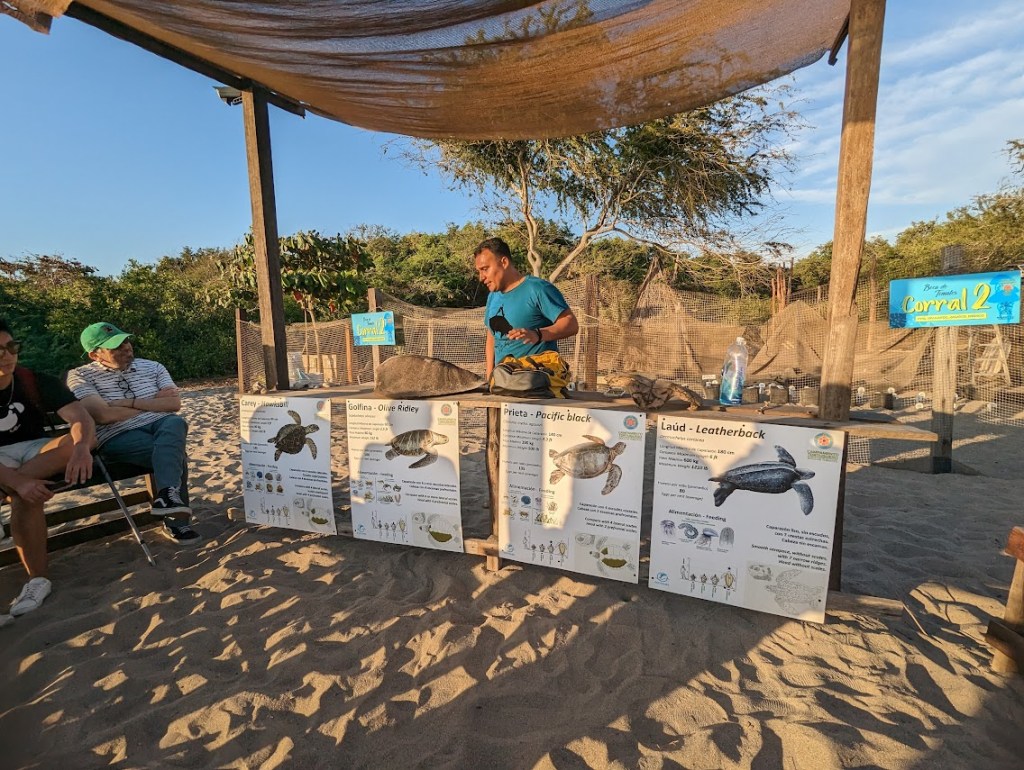
“What should you do if you see a sea turtle on the beach?” Eduardo, an educator with exceptional knowledge and linguistic skill, quizzed our group of eleven.
“Leave it alone!” said a ten-year-old boy who, you could tell, was practically tearing himself apart with the need to both prove that he already knew everything and also to learn absolutely everything there was to know. “Don’t touch it with your dirty, germy hands!”
We were discussing adult turtles about to lay a clutch of eggs, but my thoughts flashed guiltily back to the baby sea turtle of five years ago.
“That’s right,” our guide agreed. “We have germs that could hurt the turtle, but what are some other reasons not to touch them?”
The boy wiggled with the urge to answer, but he was at a loss for other ideas.
“We don’t want to scare them,” the guide continued. “If we scare them, they’ll go back into the ocean without laying their eggs. If that happens too many times, they’ll lay their eggs in the ocean, and then they will never hatch.”
I nodded along. Of course. Of course I would never do that to a nesting mother. How obvious.
“There’s another reason,” the guide continued. “This is a reason you never touch any sea turtle at all. Not the eggs, not the adults, and not the babies. Not even if you think it needs help. It’s the reason you see all our volunteers wearing gloves.”
Uh oh, I thought, thinking of baby birds again.
“Salmonella,” the guide continued, when no one could guess the answer. “Sea turtles carry salmonella, and that is very dangerous for humans. We are doing good work here, but our own safety must always come first.”
I relaxed a little. Five years had passed and I was still alive, so I was probably okay. I silently applauded myself for my excellent hand-washing habits.
We learned more: poachers are the greatest threat to sea turtles, well beyond the natural threats posed by predators or the unnatural threats of pollution, fishing nets, and habitat loss. Dozens of volunteers (who must be certified and badged) comb the beaches every night searching for the turtle tracks to-and-from the water that imply the presence of a nest. Their mission is to dig up the eggs before the poachers have a chance, and take them to a turtle camp where they can incubate in safety and science. Eggs are counted, calculated, and monitored. Once hatched, the turtles are released at either sunrise or sunset, which is the time of day most sheltered from natural predators.
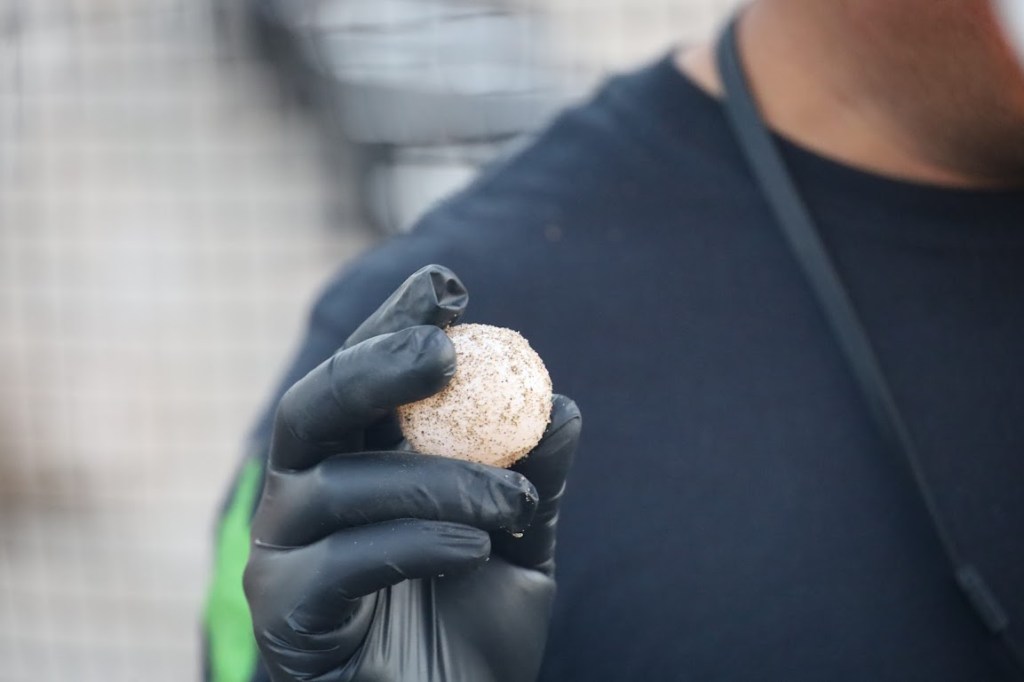
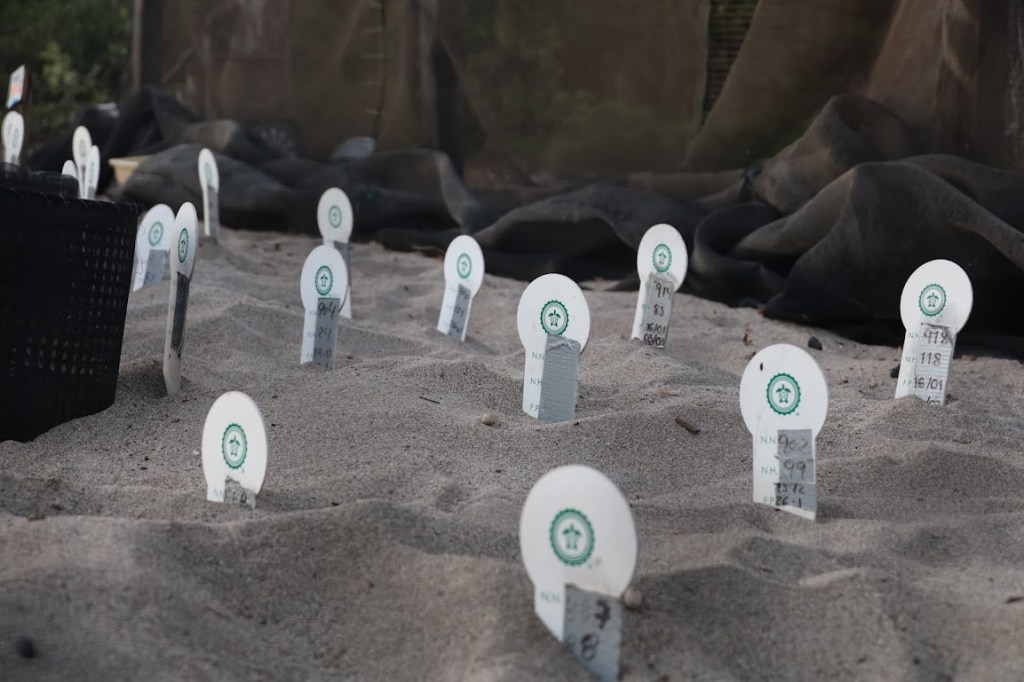
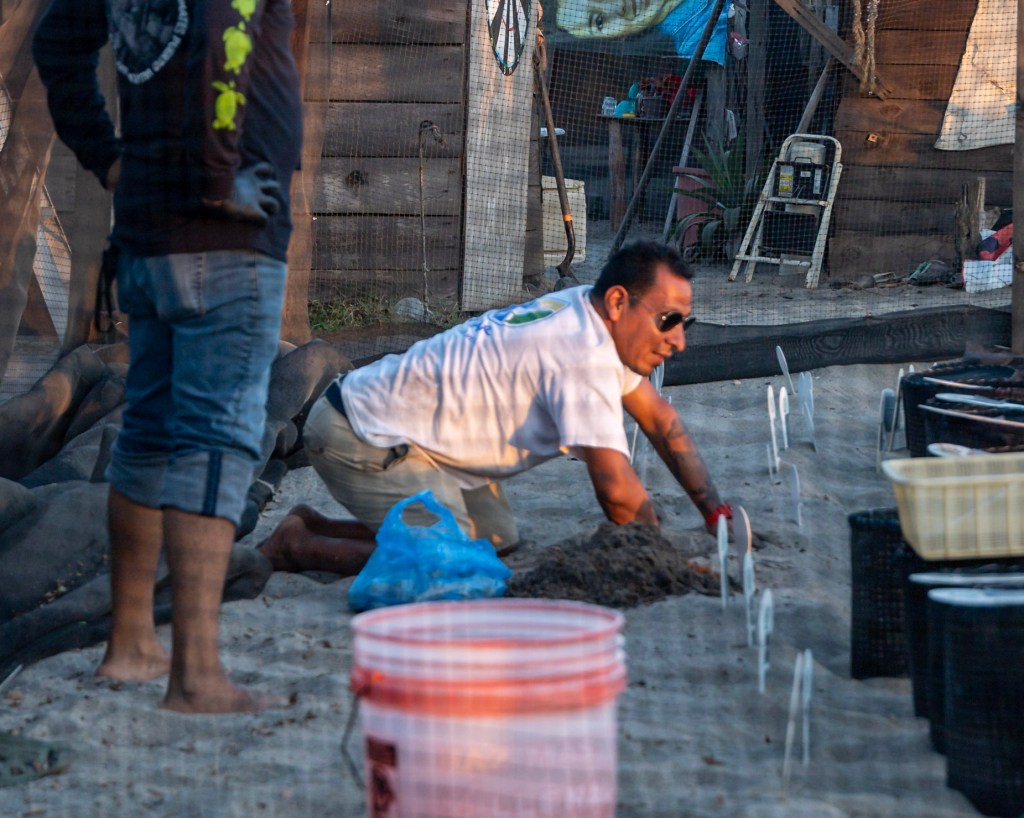
“The sun is low enough,” Eduardo said. “I will go get the turtles.” My ten-year-old buddy hopped around with anticipation.
Our turtles – hard not to feel possessive when we would get to personally escort them to the ocean – were Olive Ridley turtles, tortugas golfinas in Spanish, or lepidochelys olivacea if you prefer Latin. These turtles are among the smallest of the world’s sea turtle species, though their migration patterns can span the globe. They eat algae, many varieties of small shelled and unshelled sea critters, and enjoy an occasional jellyfish snack. In some parts of the world, nesting mothers swarm the beaches in the thousands – a behavior known as arribada nesting – and lay millions of eggs in a small window of time. Those beaches are guarded by soldiers with big guns. The beaches here only host solitary nesters, though still in remarkably large numbers.
Eduardo returned with a plastic crate and we finally laid eyes on our turtles. Several dozen turtles no more than three inches long crept and tumbled over each other in an effort to escape the crate.
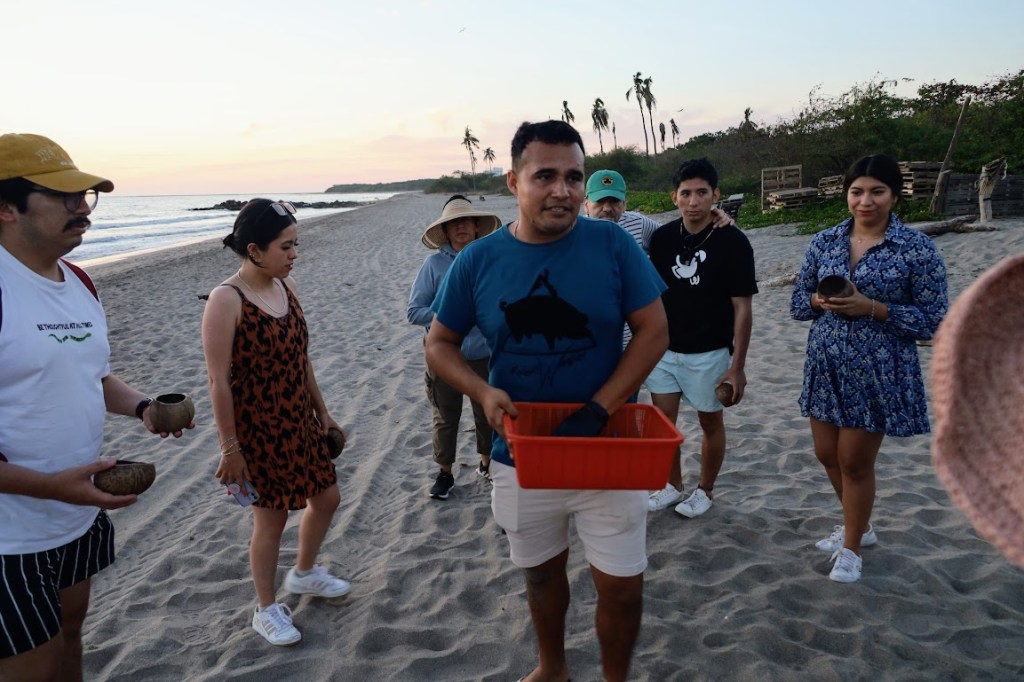
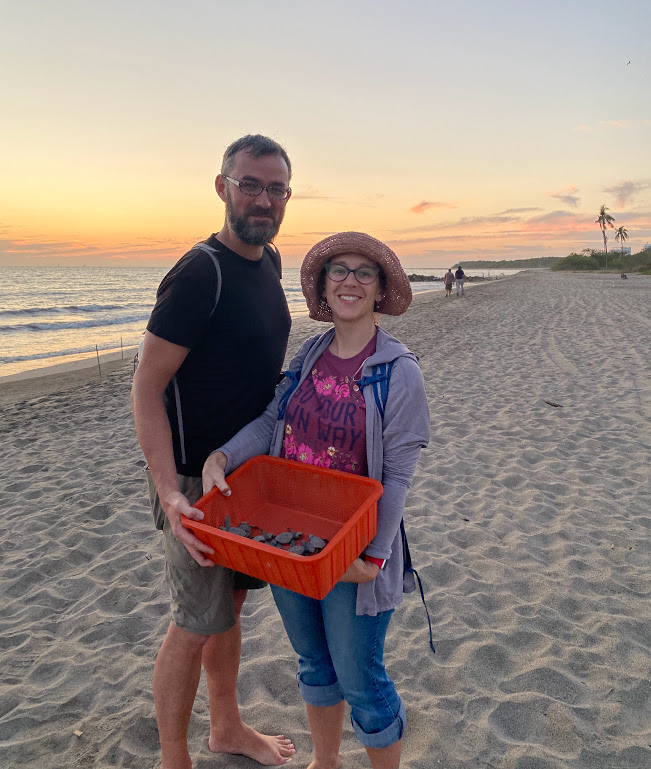

He gave us each a chance to pose with the basket then led us toward the water, stopping at a rope line that had been stretched across twenty meters of sand parallel to the water. Between the rope and the waves, the sand had been raked smooth.
“One in one thousand turtles will survive the trip from its eggshell to the ocean,” Eduardo told us. “That’s a nature fact. So why don’t we help them more? Why don’t we put them right into the water?”
I thought again of the five-years-ago turtle. Had I doomed it by escorting it all the way into the water?
“They have to learn the beach,” Eduardo explained. “The females who survive will return to this beach in fourteen years to lay their own eggs. By fighting their way down the beach into the water, we believe we help them learn what they need to know to return here. But we give them the best chance possible, eh? In the wild, the egg would have hatched all the way up there.” He pointed up to the line, half a football field away, where the sand met the jungle scrub. From where we stood, the turtles would only have to go four or five meters to meet the lapping waves. “We make the sand smooth, and we wait for the predators to go.” We all turned to eye a frigate bird who seemed to be lingering in the sky above as if it knew what we were up to.
“We help,” Eduardo emphasized, “but we can’t do the work for them.” I felt like he was talking to me specifically.
Each of us received a coconut shell with the top trimmed off to serve as our salmonella shields. Eduardo placed a tiny turtle into each shell and instructed us to “give it a name and a wish.”
Dustin handed me his coconut shell so he could take a photo. I looked at the two turtles in their shells and felt a weight of responsibility. A name and a wish? For a turtle whose odds of survival were one in a thousand?
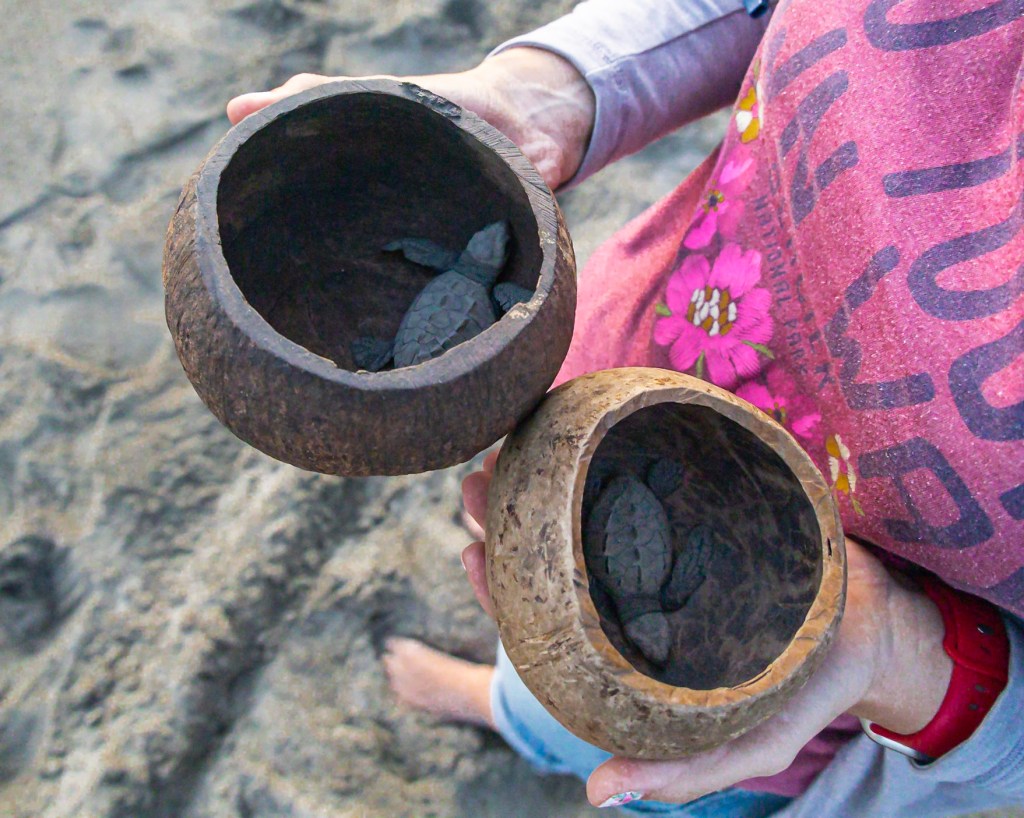
“I think mine is broken,” I said, wanting it to be a joke but worried that the turtle in my coconut might already have lost the battle. In the other coconut, Dustin’s turtle scrambled enthusiastically up the side of the concave shell, not content to wait for its release. Mine sat in its shell, not moving. Then its flippers flapped a little, and I felt relieved.
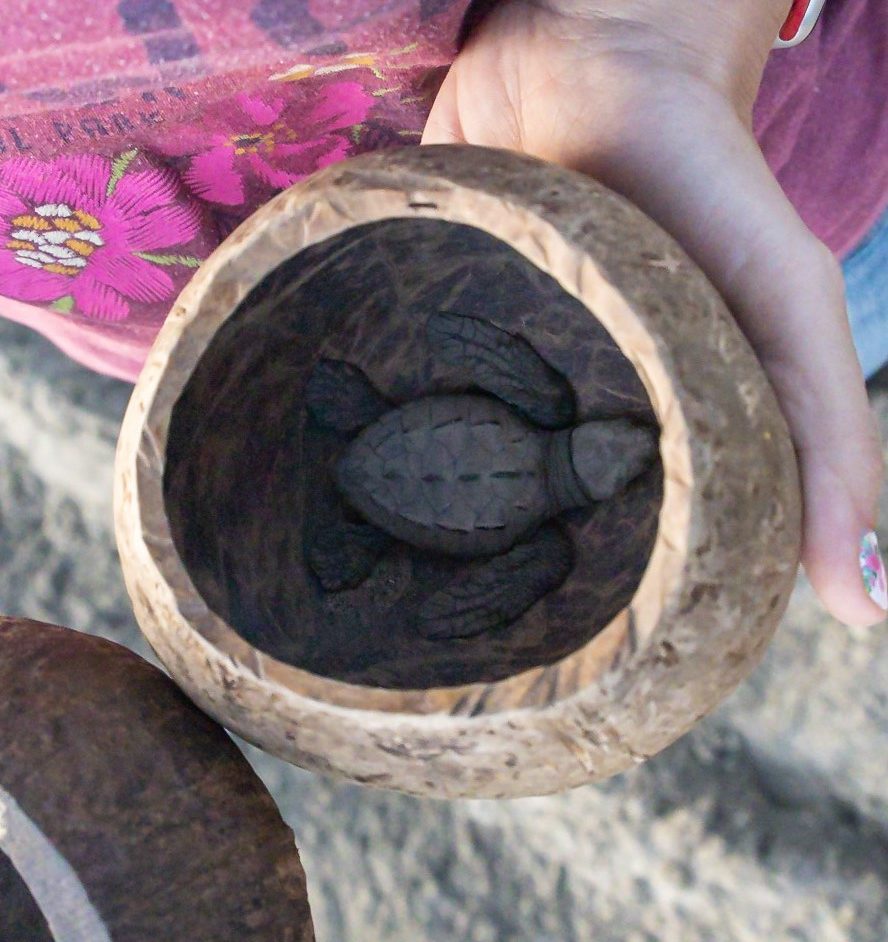
A name felt too heavy a burden to place upon this turtle. And what kind of wish was I supposed to make? Did you wish upon a baby turtle like you wished upon a star? Or was the wish meant to help combat its incredibly low odds of survival?
I thought of my turtle as Tiny Friend, not a name exactly, and wished it the most pleasant possible remainder of its very short life. And then, sneaking in a second wish, I wished it would prove my assumption wrong.
Once the frigate bird had cleared out, Eduardo announce a countdown and we all lowered our coconuts to the ground. Dustin’s turtle sprang from its coconut and began wrestling its way through the sand toward the water.
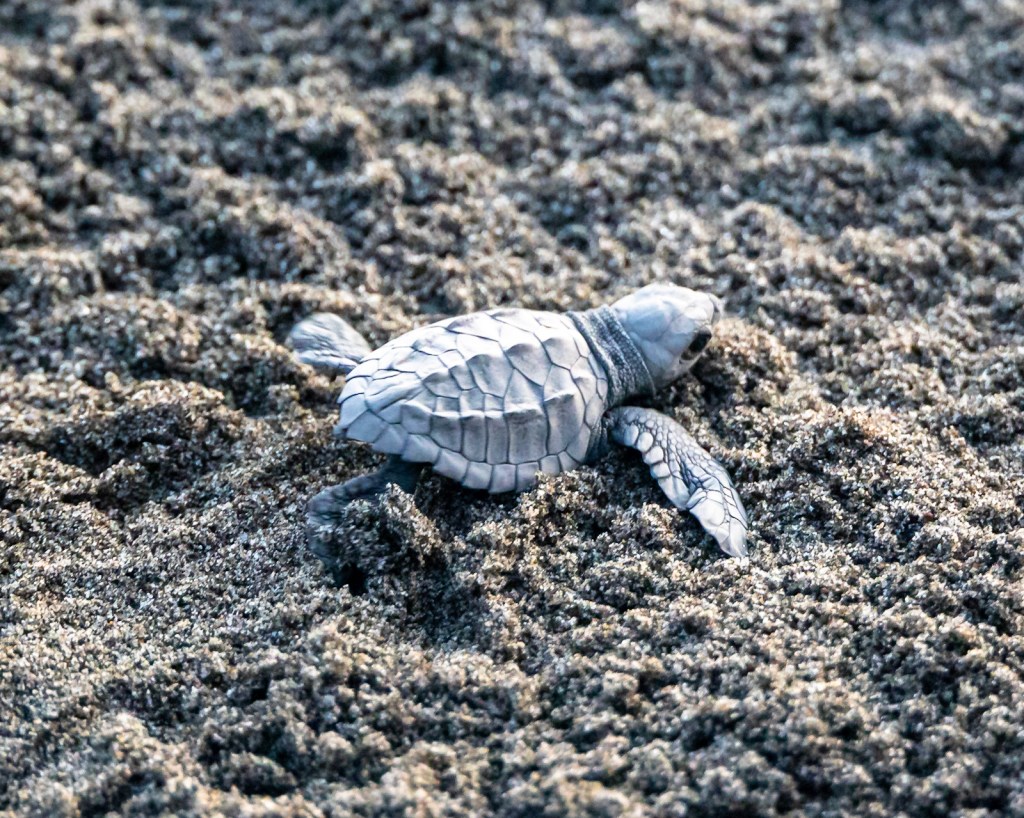
I had to shake my tiny friend free of its coconut. It lay on the sand, not moving. I tried not to take it personally. If my turtle had also raced to the water, I’d still have seen the other slow turtles and felt sad. And this turtle was not, in reality, my turtle. It was one of a thousand and the odds were not in its favor no matter how fast it moved to the water. Still, my heart felt heavy as I watched it where it sat, unmoving, in the indent left by the coconut.
And then my tiny friend flapped its tiny flippers and scooted forward a couple inches.

“Yes! Yes! You can do it!” I cheered. The turtle stopped. Most of the other turtles crept along slowly but steadily. My tiny friend made another small effort and paused again. It might have been tired, it might have been battered by all those other turtles crawling around on top of it trying to get free, but it wanted to go. It wanted to get to the ocean. It wanted to be the one who survived, despite the huge odds.
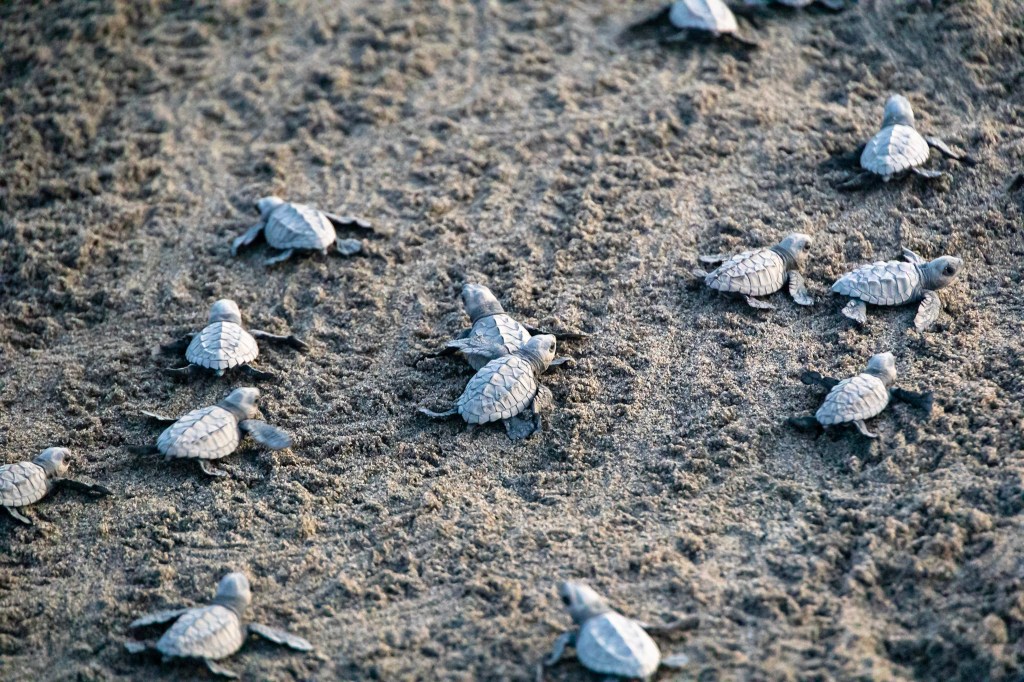
We watched as the first turtles met the foamy edges of the waves and were eventually swept into the deeper waters. Dustin’s was among the first, but many others soon followed. A few got confused and didn’t seem to know which way to scoot. A few others besides mine didn’t seem to have the oomph to make the trip, though I was grateful to see none were perfectly still.
“So what should one do if one finds a baby sea turtle laying washed up on a beach?” I asked Eduardo, no longer able to stand it.
“Nothing,” Eduardo said simply.
“Even if it’s laying on its back, flippers flopping around because it’s stuck?” I asked. Totally hypothetical.
Eduardo glanced down, and then back up. He had me pegged, I was sure of it. “Let me tell you something, as a scientist and a human being. This is nature. We want to help the baby turtles because they are endangered, and because they are very cute it is easy to want to help, but the reason so few survive is because they are also food for other animals. The birds have to eat too, eh?”
I nodded, feeling more comforted by this than I would have expected.
As the time for us to depart approached, Eduardo and several other certified volunteers made a sweep of the sand, picking up stragglers and escorting them to the edges of the waves. Birds may have to eat, and turtles may thrive best if they have to fight, but today, no turtle would be left behind.
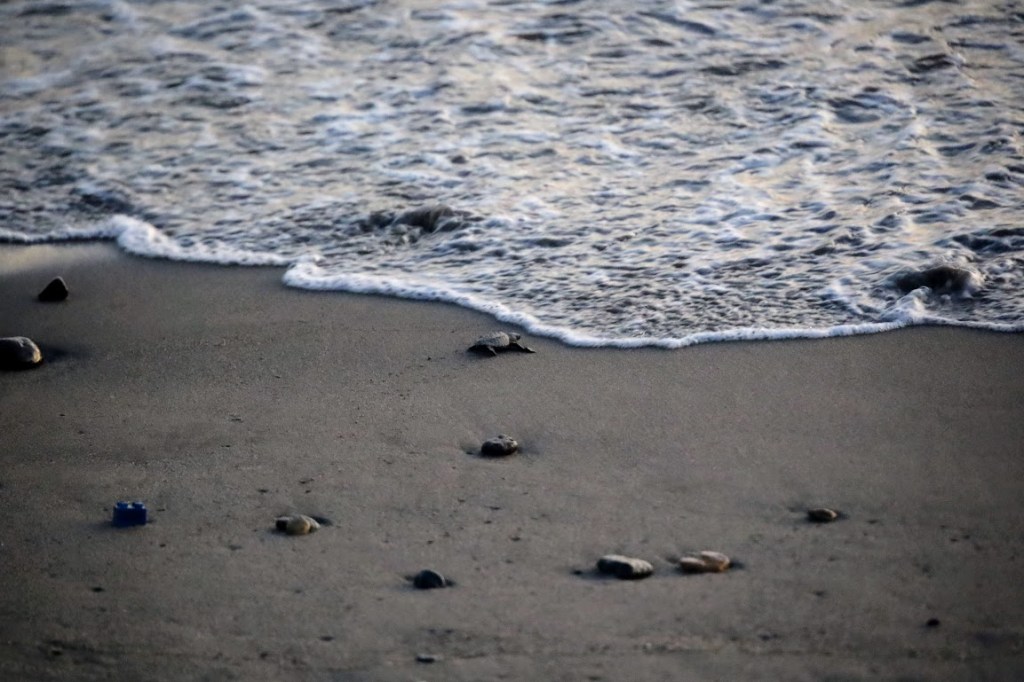
My tiny friend had made it nearly to the line where the highest wave had swept the sand when Eduardo scooped it up and set it in the sand at the very edge of the water. Our group pulled out and began to gather for the walk back down the beach, but I lingered, watching the speck that might have been a stone on the sand, except for the occasional flutter of a flipper as my tiny friend managed another inch, and then two. A wave came at last and pulled it into the ocean, a place I find more terrifying than any other, but the only place it could call home.
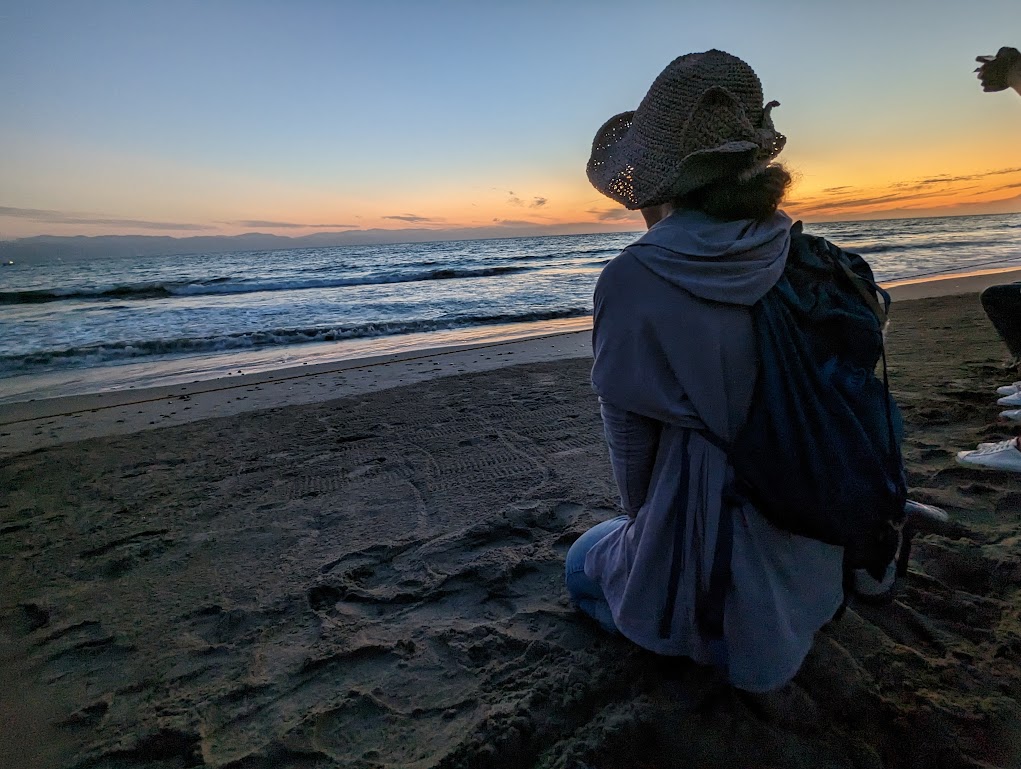
And who knows what the water holds? Maybe my slow-moving friend will survive because it is more cautious, or because the timing was coincidentally good, or because of something I can’t even guess. Maybe it will make it despite all the odds, and maybe I helped tip the balance the tiniest bit in its favor. I’ll never get to know, but I have no reason not to hope.
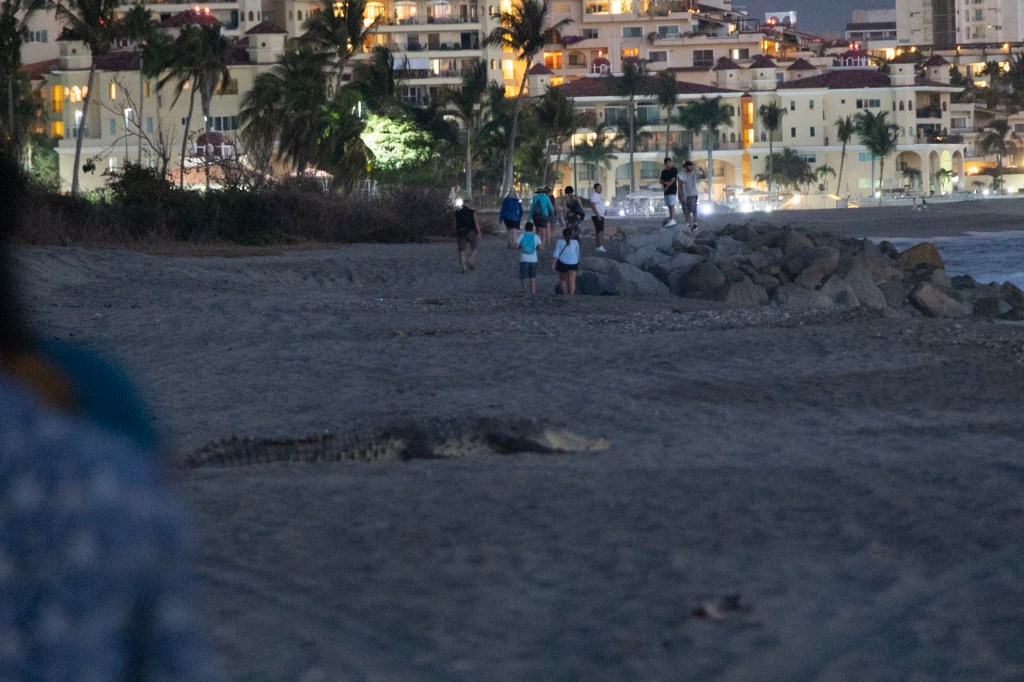
Dustin says: “In the end, the crocodiles come for us all.”
There are a number of ways you can participate in sea turtle releases, or just visit sea turtle camps to learn more about turtles and the conservation work done by volunteers. AirBnB is evil, but I do recommend the experience hosted by Eduardo, which can be found here. Other options can be found by searching “sea turtle release Puerto Vallarta.”
 Thither & Yon