For a transcription of these photographed journal pages, please scroll down! A fancier blog post with loads of pictures will hopefully get posted someday.
Transcription of photographed journal pages:
Tuesday, May 3, 2022
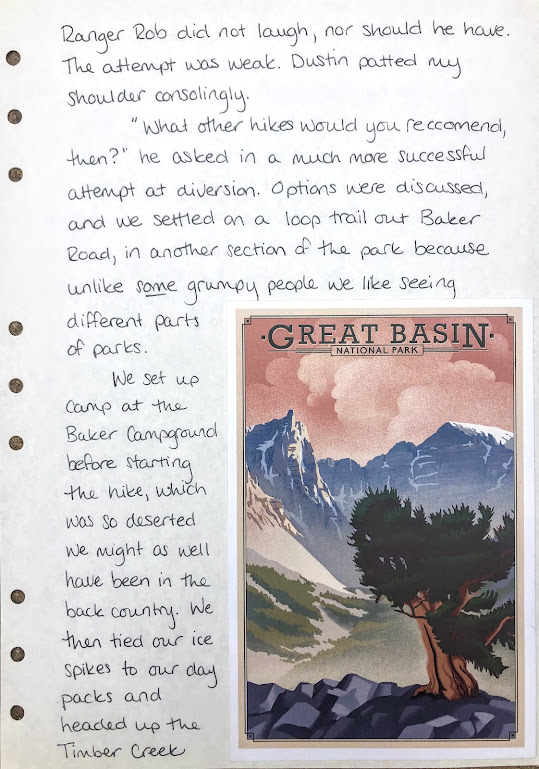
GREAT BASIN NATIONAL PARK
Who knew Nevada was so high??
In my defense, apparently I’ve spent my whole life under the impression that Nevada is 98% salt flats and 2% Las Vegas. Turns out there’s a lot of Nevada that isn’t those things!
We arrived [in Great Basin] in time for our reserved tour of Lehman Caves. If the rest of our visit was any indication, people come to this park just to see Lehman Caves the same way they go Dinosaur NM just for the bone quarry. “What else is there to do up here?” I heard one visitor ask a ranger. He proposed a number of scenic drives which also led to trailheads.
“Right,” the visitor said, “but those are in different parts of the park.” This park is not large. Woe unto that woman in Yellowstone, if she needs all points of interest to be in a single square mile.
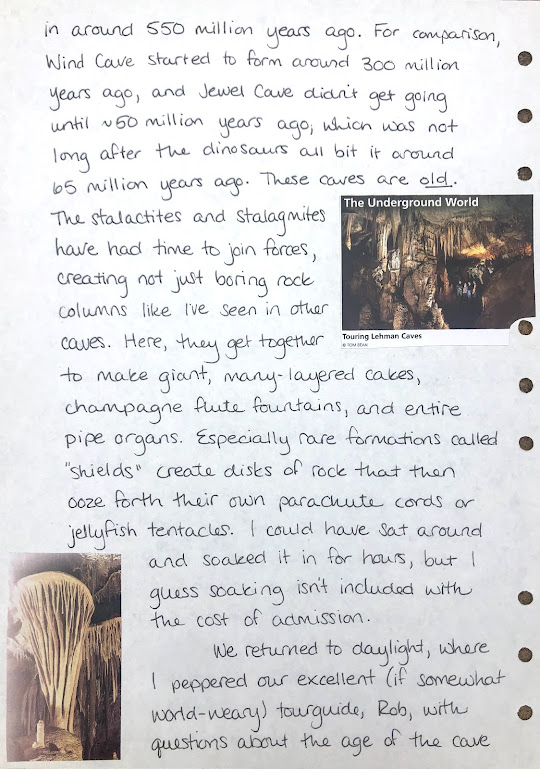
The cave tour was excellent, and the cave itself is freaking magnificent. It’s an old, old cave, with its initial formation period clocking in around 550 million years ago. For comparison, Wind Cave [in South Dakota] started to form around 300 million years ago, and Jewel Cave [also in South Dakota] didn’t get going until around 50 million years ago, which was not long after the dinosaurs all bit it around 65 million years ago. [Lehman] Caves are old. The stalactites and stalagmites have had time to join forces, creating not just boring rock columns like I’ve seen in other caves. Here, they get together to make giant, many-layered cakes, champagne flute fountains, and entire pipe organs. Especially rare formations called “shields” create disks of rock that then ooze forth their own parachute cords or jellyfish tentacles. I could have sat around and soaked it in for hours, but I guess soaking isn’t included with the cost of admission.
We returned to daylight, where I peppered our excellent (if somewhat world-weary) tourguide, Rob, with questions about the age of the cave (see above), the difference between limestone and marble (how was I already today years old when I learned that marble is metamorphosed limestone??), and how this cave completely avoided being upset by tectonic and mountain-forming events over the last half a billion years (this is the point at which he started to wonder what my deal was, and also he didn’t know).
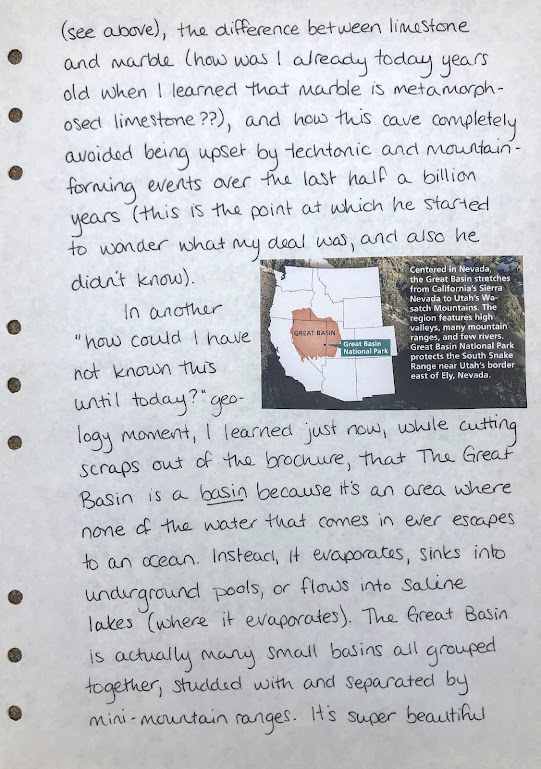
In another “how could I have not known this until today?” geology moment, I learned just now, while cutting scraps out of the brochure, that The Great Basin is a basin because it’s an area where none of the water that comes in ever escapes to an ocean. Instead, it evaporates, sinks into underground pools, or flows into saline lakes (where it evaporates). The Great Basin is actually many small basins all grouped together, studded with and separated by mini-mountain ranges. It’s super beautiful and varied, leading us back to the surprise I initially expressed in this entry.
Back at the visitor center, we switched to querying Ranger Rob about how to conduct the rest of our visit.
“I know the road up to Wheeler Peak is closed, but I wondered if there is still some hike or other viewpoint to see the glacier… ?” [I asked.] Nevada’s only glacier calls Great Basin NP home, so this was the only possible question to start with.
“There’s no glacier anymore,” Ranger Rob said, dashing my dreams and cracking my heart the way only a jaded soul who doesn’t know he’s talking to a fanatic can.
“What?” I asked in a tiny, sad voice.
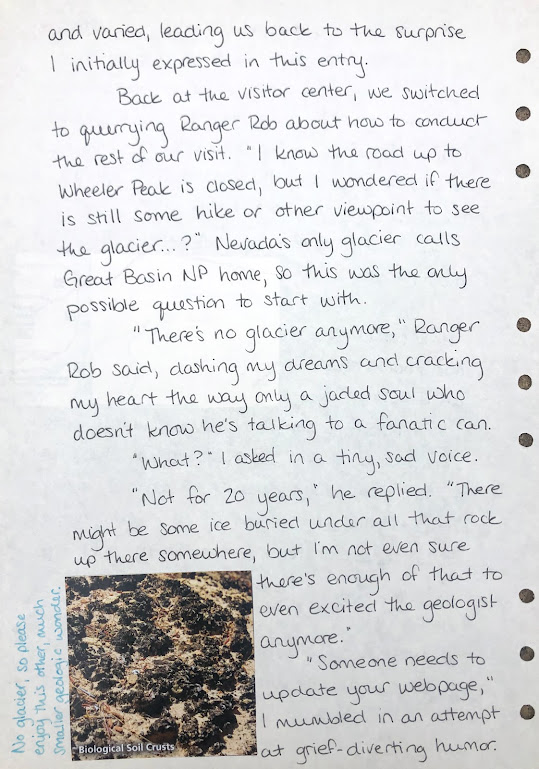
“Not for 20 years,” he replied. “There might be some ice buried under all that rock up there somewhere, but I’m not even sure there’s enough of that to even excited the geologist anymore.”
“Someone needs to update your webpage,” I mumbled in an attempt at grief-diverting humor.
Ranger Rob did not laugh, nor should he have. The attempt was weak. Dustin patted my shoulder consolingly.
“What other hikes would you reccommend then?” [Dustin] asked in a much more successful attempt at diversion. Options were discussed, and we settled on a loop trail out Baker Road, in another section of the park because unlike some grumpy people, we like seeing different parts of parks.
We set up camp at the Baker Campground before starting the hike, which was so deserted, we might as well have been in the backcountry. We then tied our ice spikes to our day packs and headed up the Timber Creek Trail, where – sure enough – we started encountering snow almost right away. We congratulated ourselves on the foresightfulness of bringing the spikes, and strapped them on. Only to, y’know, wind up on and off and on and off the snow for the rest of the hike. There was a solid mile toward the top when it was quite wonderful to have them, anyway.
At the top, the trail opened into a wide, totally snow-free meadow, saddled between several tall, pointy peaks (one called Pyramid for obvious reasons). We sat down to have a congratulatory snack. Our elevation had reached more than 9,600 feet, making this our first high hike of the year, and that plus the snow had equaled some very serious huffing and puffing toward the top.
Scenery properly soaked in, hearts and lungs adequately rested, we headed back down the mountain. Toward the bottom, we stopped to collect some dead-and-down branches to use for our first proper campfire of the trip.
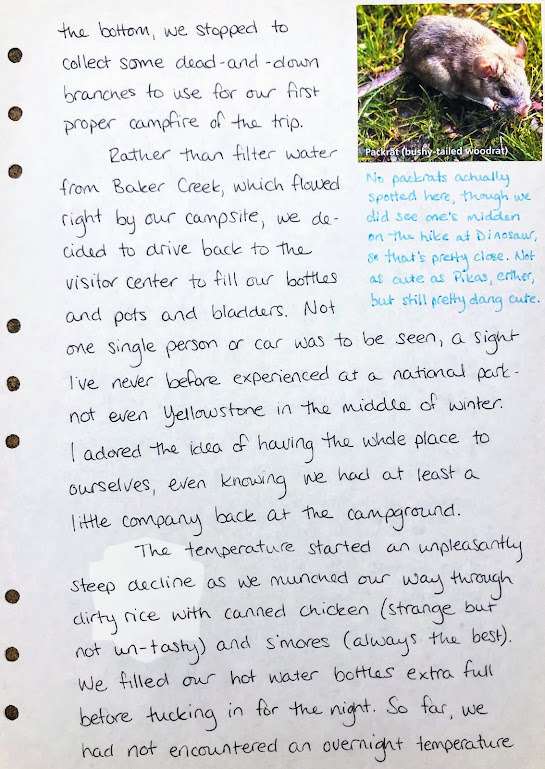
Rather than filter water from Baker Creek, which flowed right by our campsite, we decided to drive back to the visitor center to fill our bottles, pots, and bladders. Not one single person or car was to be seen, a sight I’ve never before experienced at a national park, not even Yellowstone in the middle of winter. I adored the idea of having the whole place to ourselves, even knowing we had at least a little company back at the campground.
The temperature started an unpleasantly steep decline as we munched our way through dirty rice with canned chicken (strange but not un-tasty) and s’mores (always the best). We filled our hot water bottles extra full before tucking in for the night. So far, we had not encountered an overnight temperature lower than 40°, but this night it dropped to a shivery 28°, making it officially our coldest-ever camping night. I stayed warm enough, but my brain just couldn’t accept that. It kept waking me up to make sure I wasn’t freezing to death. (In fairness to my brain, my nose did get pretty cold, guess.)
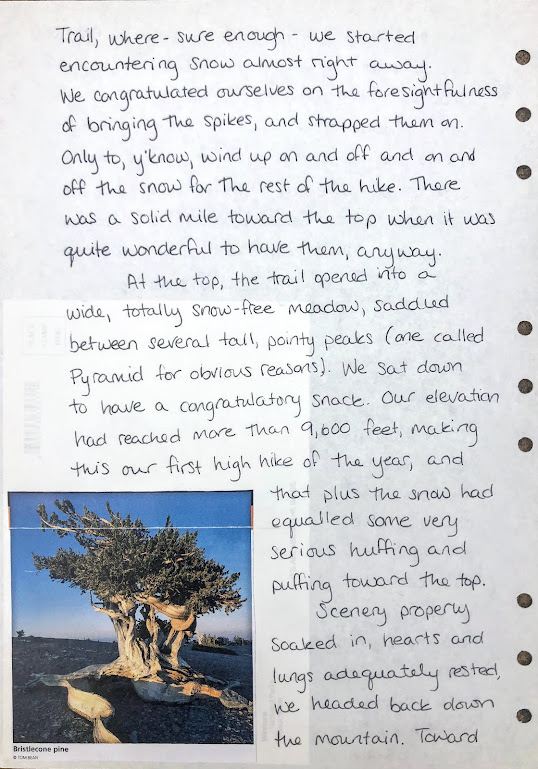
We made one more stop at the visitor center on the way out to buy postcards and ply Ranger Rob with questions about bristlecone pines. (Yes, they did cut down the oldest tree in the world in the 60s, but that’s how they discovered it was the oldest, but now they’ve found even older ones in California, topping 5,000 years!!)
Onward to California, then, though our stops will probably be too urban for the really ancient trees.
 Thither & Yon