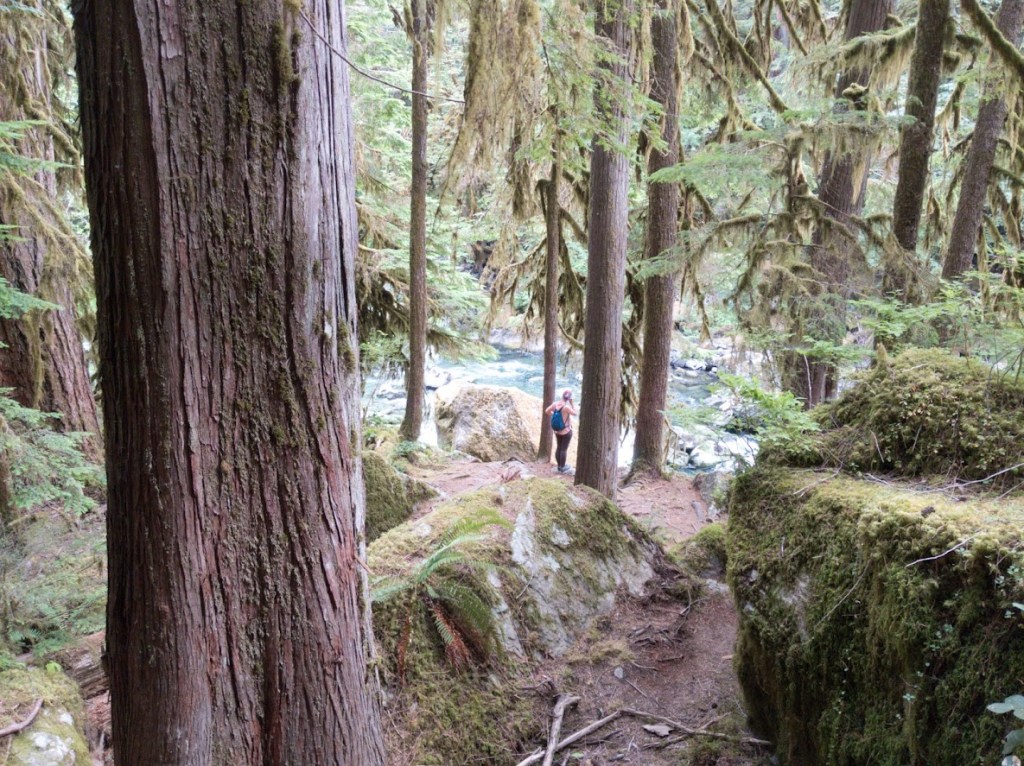
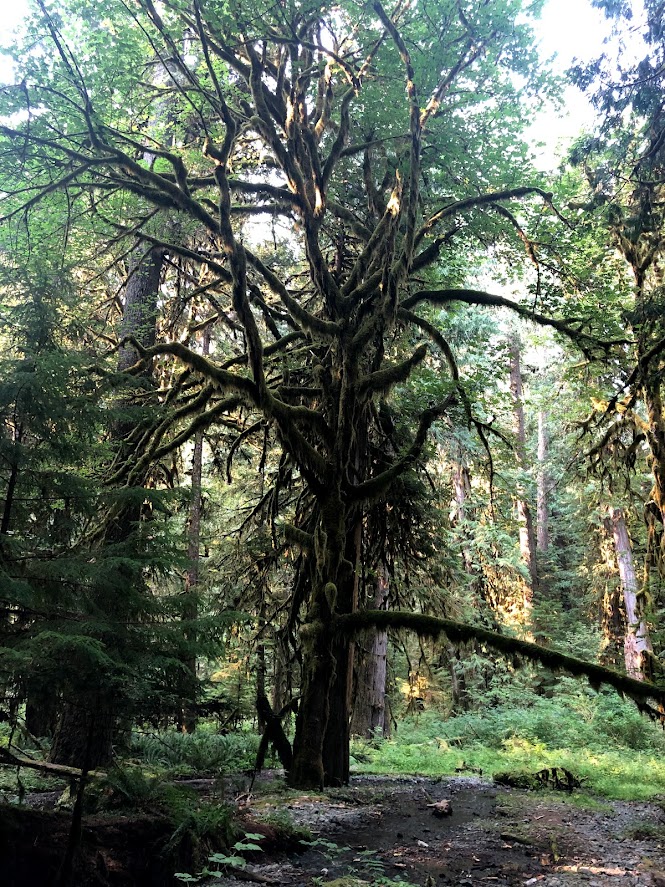
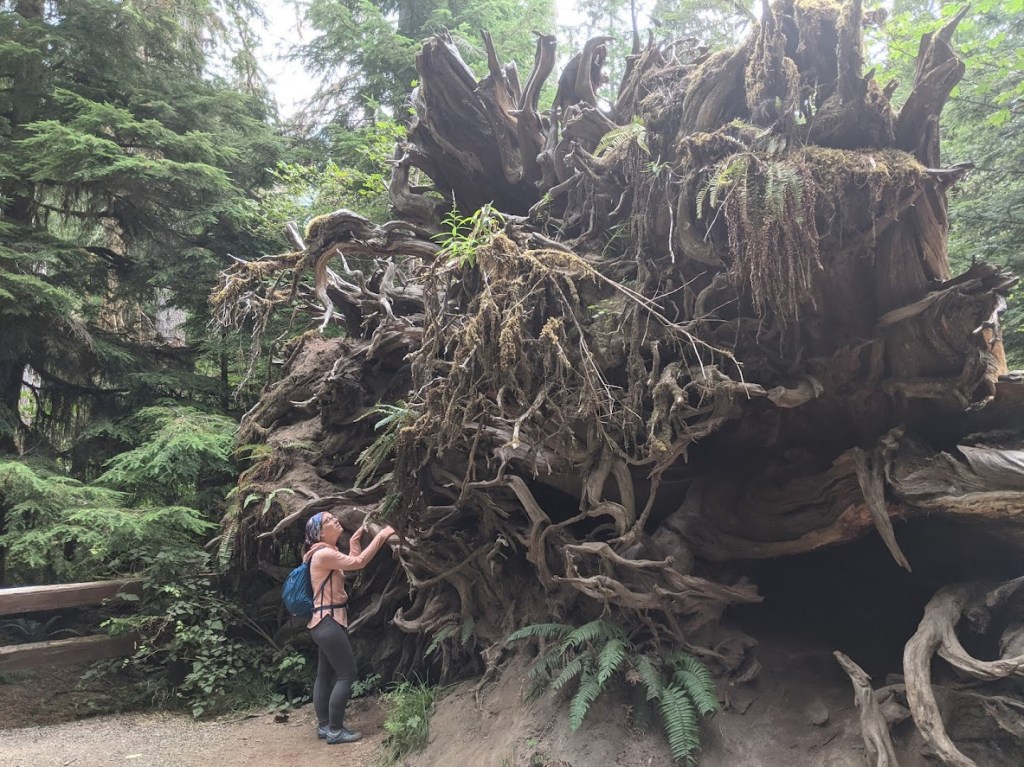
A morning spent on the Staircase River Trail is a morning well spent, but our main destination for the day was our Airbnb in Sequim (say, “squim”) up by Port Angeles and a stop at Hurricane Ridge for some more hiking.
As we went north, the smoke got thick. By now (August 1), most of California was on fire and a good chunk of Oregon and Washington too. Driving down Hurricane Ridge Road toward the visitors center, I got the feeling we might be as able to swim through the air as easily as hike through it. The smoke wasn’t deterring tourists, though, and there were plenty of cars on the road and in the parking lot.
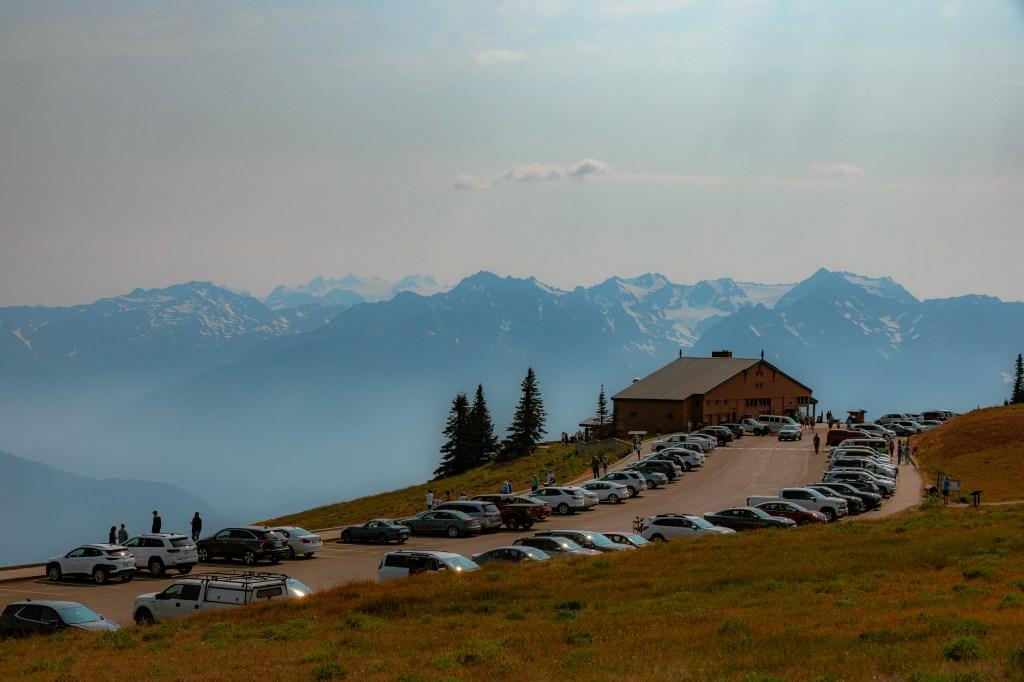
We waded through the smoke (turns out it wasn’t quite thick enough for swimming) and into the visitors center. Our first stop was the ranger on duty at the info desk.
“I hear you have nice mountains out here. When’s the last time you saw them?” I asked. Yes, I’m that tourist. I’m sorry, I can’t help myself. I even know I’m not very funny, but I still always seem to think it’s a good idea at the time.
The ranger just stared at me. Unlike the ranger in Organ Pipe Cactus NM who was really confused when I asked where to find the cactus with the bobcat in it, this guy gave me nothing.
“Views today aren’t real great,” I clarified. The ranger glanced at the enormous viewing windows that looked into the heart of the park as if to verify my claim.
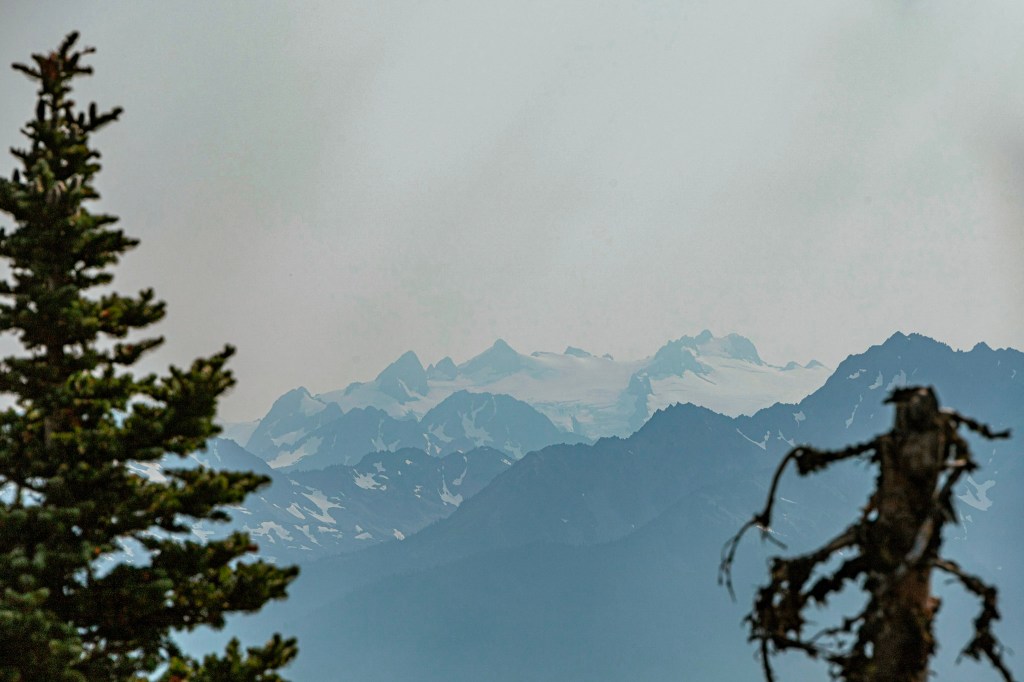
“You can see Mount Olympus pretty well if you stand by that display over there,” he said, indicating the correct display. It was literally true, as far as these things go.
“So, uh… any forecasts on when the smoke might clear out a little?” I asked, trying to recover.
“It depends on the wind,” the ranger said. I squinted at him. Perhaps his non-reaction to my bad joke was a deeper personality flaw.
“We were thinking about doing the Klahhane Ridge Trail,” I pressed on, “but I’m starting to wonder if there’s any point in doing that with the smoke so thick.” What I meant was: “is it worth the effort of hiking 5 miles and gaining 1,700 if there are no views?” What he answered was “Here’s a map that shows the trail. If you take X junction the trail will be like this. If you take Y junction you’ll have some ascent but the views can be really nice.”
I decided that the ranger wasn’t actually trying to mansplain wind or maps to me, but that he was already burned out and could only give one fixed set of speeches. One too many dumb tourists had made bad smoke jokes and asked him the same questions, and today was only the first of August.
I thanked him for the information and we waded back out into the smoke.
“What do you think?” Dustin asked. The air was kind of chewy.
“I don’t think I need to do five miles in this,” I replied. In fact, I was feeling pretty glum. We’d come a long way and I’d really coveted a great view of that glacier, even if I couldn’t go collect it. I knew something amazing lay out there past the smoke, but it was only a chalky outline.
“Let’s go up to that ridge,” Dustin said. “It’s not far, and we can turn around if the air is too thick, but maybe we’ll see something.”
I agreed, because when I get glum all I really want is for someone else to make the decisions.
The ridge in question was the start of the trail that would have led us to Klahhane Ridge, but on this occasion we just took the short spur up to Sunrise Point. You could tell the views would have been spectacular, at sunrise or any other time, but today they were all lost behind a translucent pane.
By now it was 5:00 and it seemed that the cure for visibility disappointment might be a good dinner and night’s sleep, so we headed back to town to cruise for not-pouch-food.
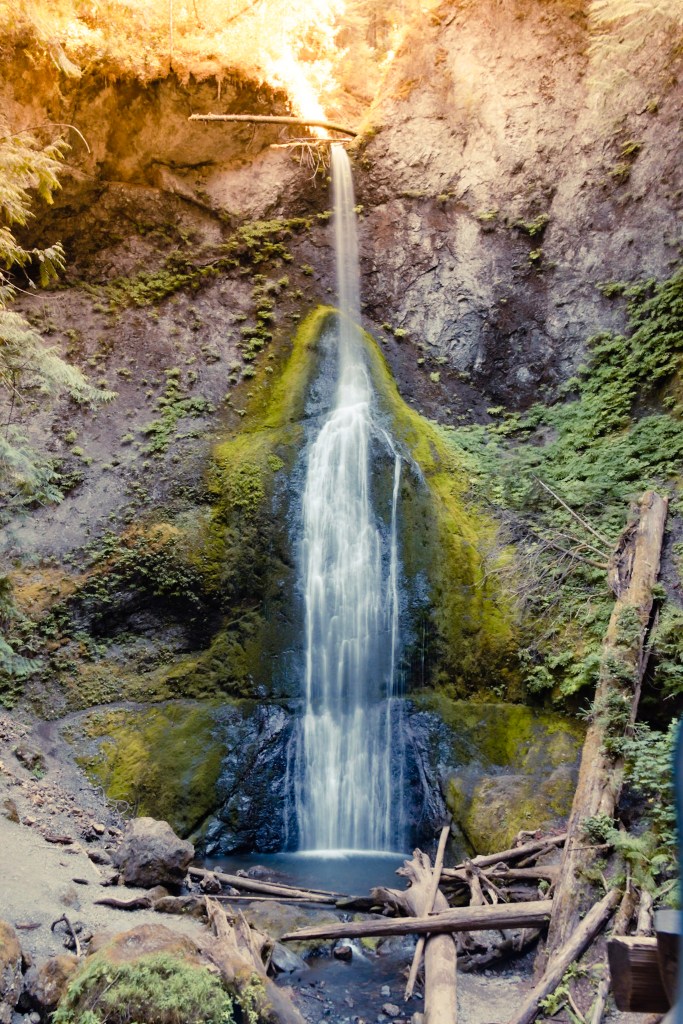
We spent our third day out on Third Beach, but I’m going to save that adventure for its own blog post, so let’s skip ahead! In the meanwhile, please enjoy this photo of Marymere Falls from our brief stopoff there:
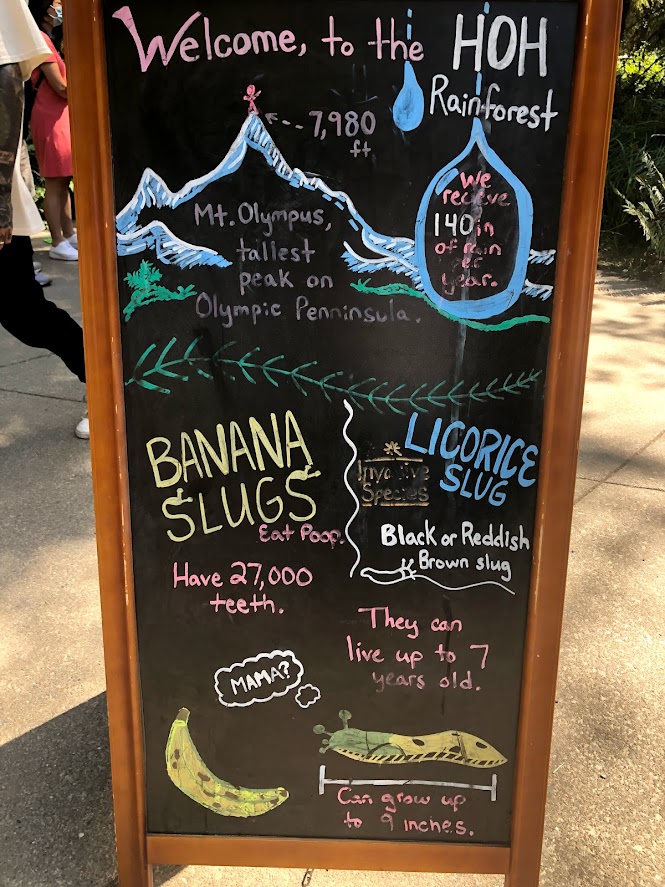
Tuesday afternoon, we scrambled off of the beach and headed to the rainforest, because that’s how it works in Washington. The welcome board at the Hoh Rainforest Visitors Center was my favorite from the whole trip:
We had a reservation for camping at the Five Mile Island backcountry campground tonight. We stopped in at the backcountry desk to confirm the reservation and get any pointers. The ranger on duty here still had a spark of interest in humanity and assured us the trail would be fairly kind (we already had almost four beach miles on us) and that our permit would allow us to stop at any of the first four campgrounds along the trail, so if we pooped out early or found a little extra energy, we didn’t absolutely have to stay at Five Mile Island. She also pointed out a few items of particular interest we might look for along the trail. We thanked her and headed out into the rainforest.
My first thought upon pressing into the deep green tunnel of trees was that it was too quiet. I am pretty sure rainforests are supposed to drip. There was no dripping at all, or really any other moistness to speak of. This poor rainforest was bone dry. July is not known for being one of the wetter months in the park, but surely a couple little drips weren’t too much to ask?
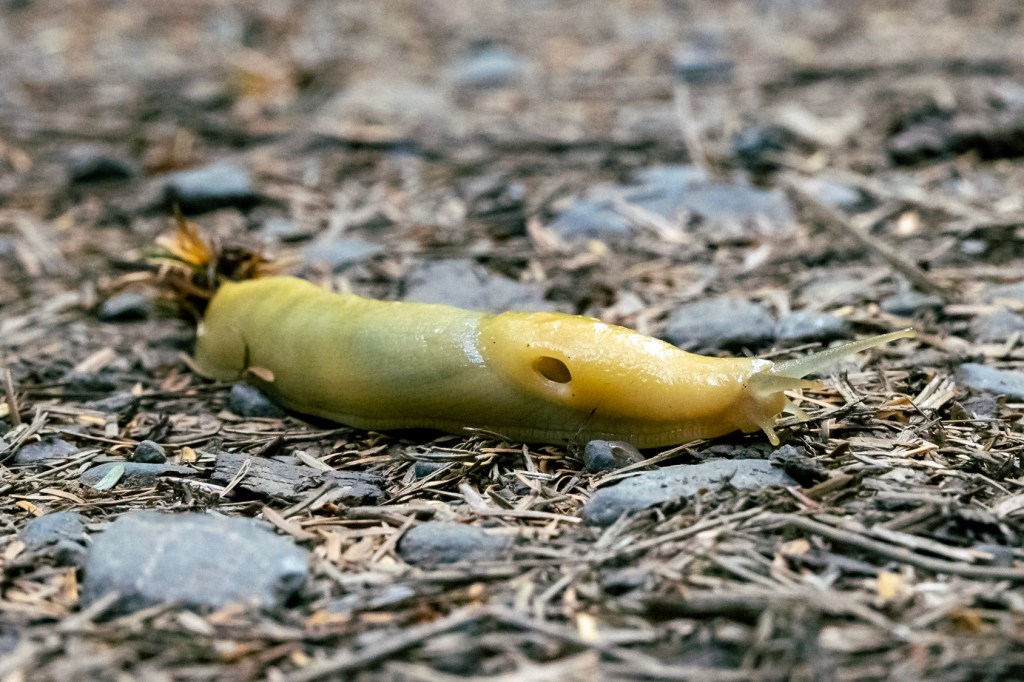
A little drought doesn’t bother banana slugs.
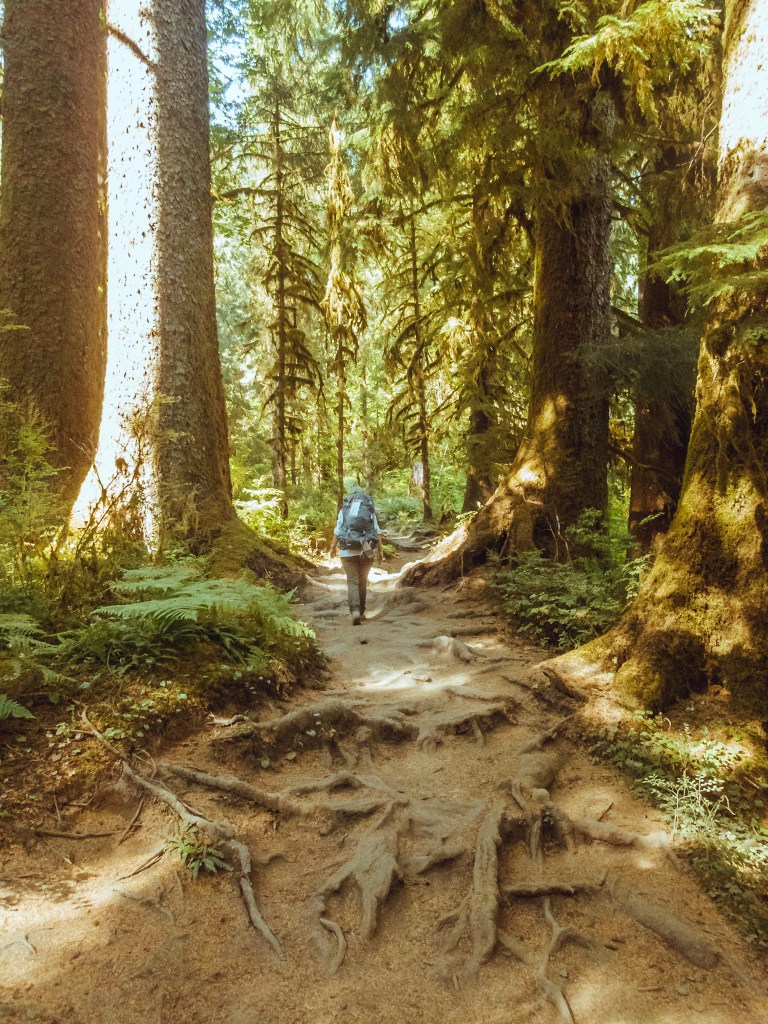
Drips or no drips, this is one beautiful forest.
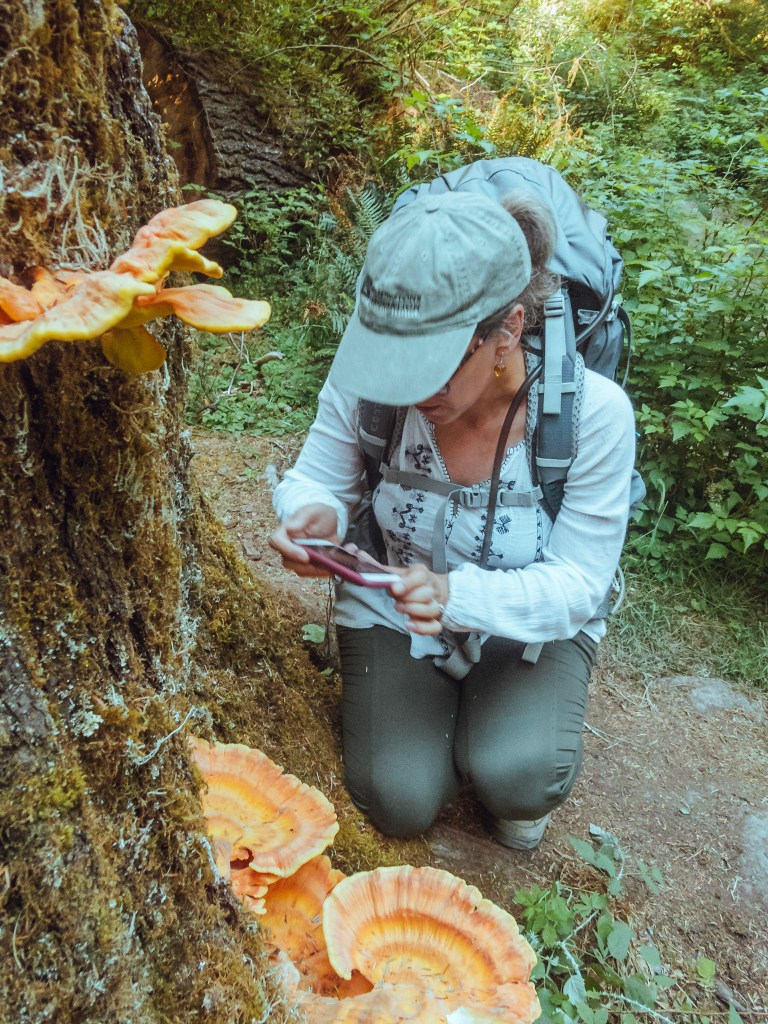
And then I found these super cool mushrooms, which I loved because they had magnificent orange and yellow bands.
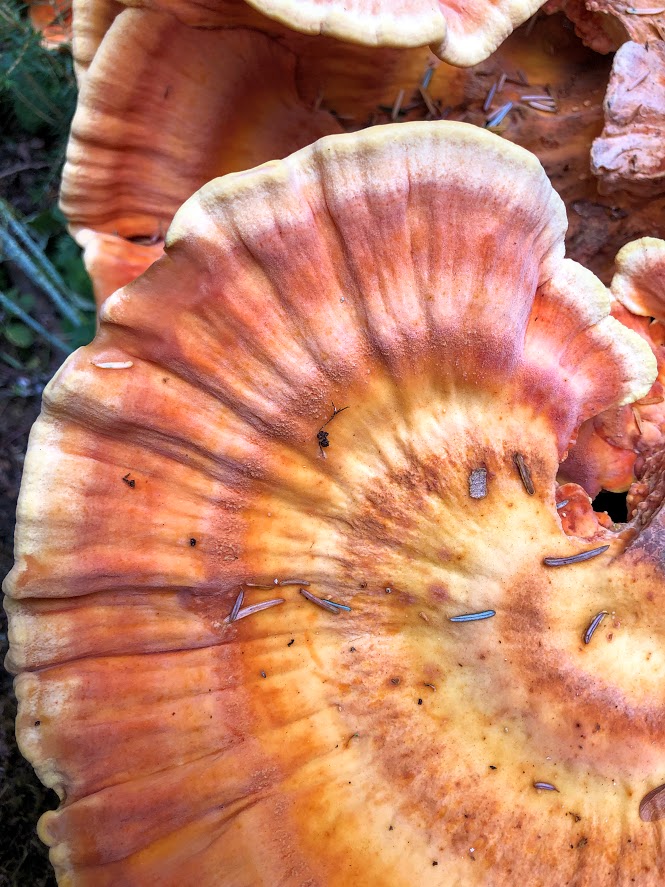
What I did not know at the time is that these are chicken-of-the-woods mushrooms, and that they are delicious. We could have had the best pouch-dinner ever. Just one of those lobes would have been an entire feast.
[YES, it is legal to collect mushrooms in Olympic National Park, limited to one quart per person per day. This allowance varies between parks, so if you’re thinking about grabbing a little log-chicken, make sure you check on regulations for your park of choice first. And as a side-note to this side-note, Olympic NP’s webpage about fungi actually contains this warning: “There are bold mushroom hunters and old mushroom hunters, but there are no old, bold mushroom hunters.”]
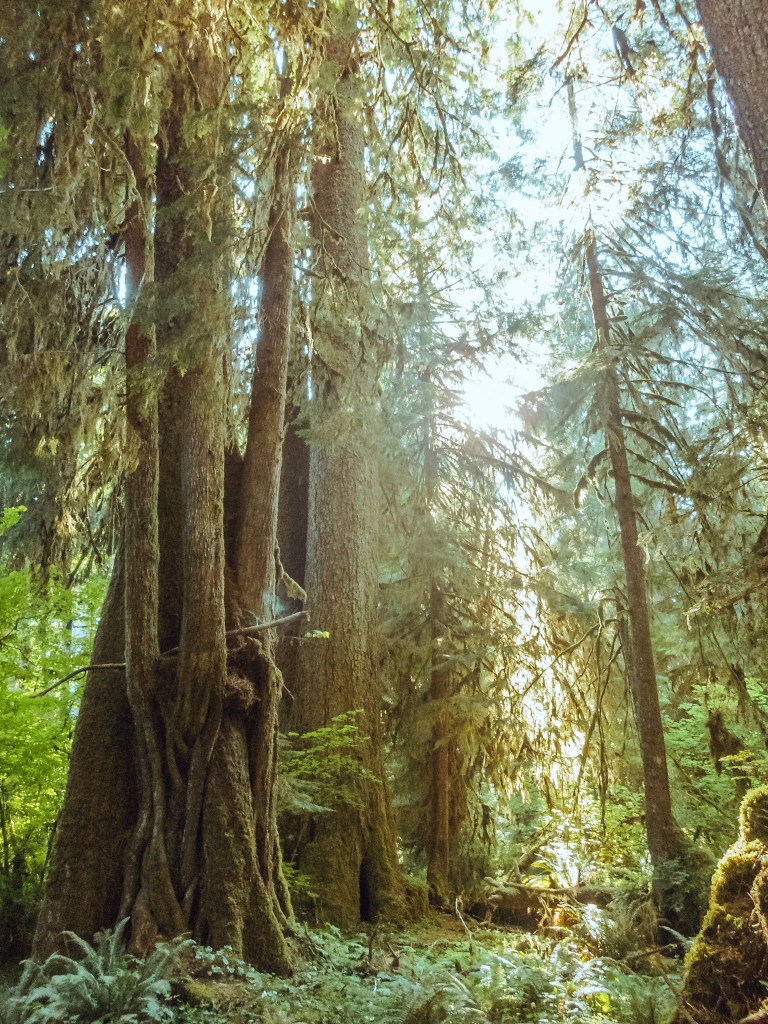
We did make it to Five Mile Island, and discovered it to be a whole tent community hidden in the backcountry of a rainforest. It was early evening by the time we arrived, and we did another .75 miles of exploring the area before we found a tent site that hadn’t yet been claimed. I’d guess there were probably 60 hikers or more in residence.
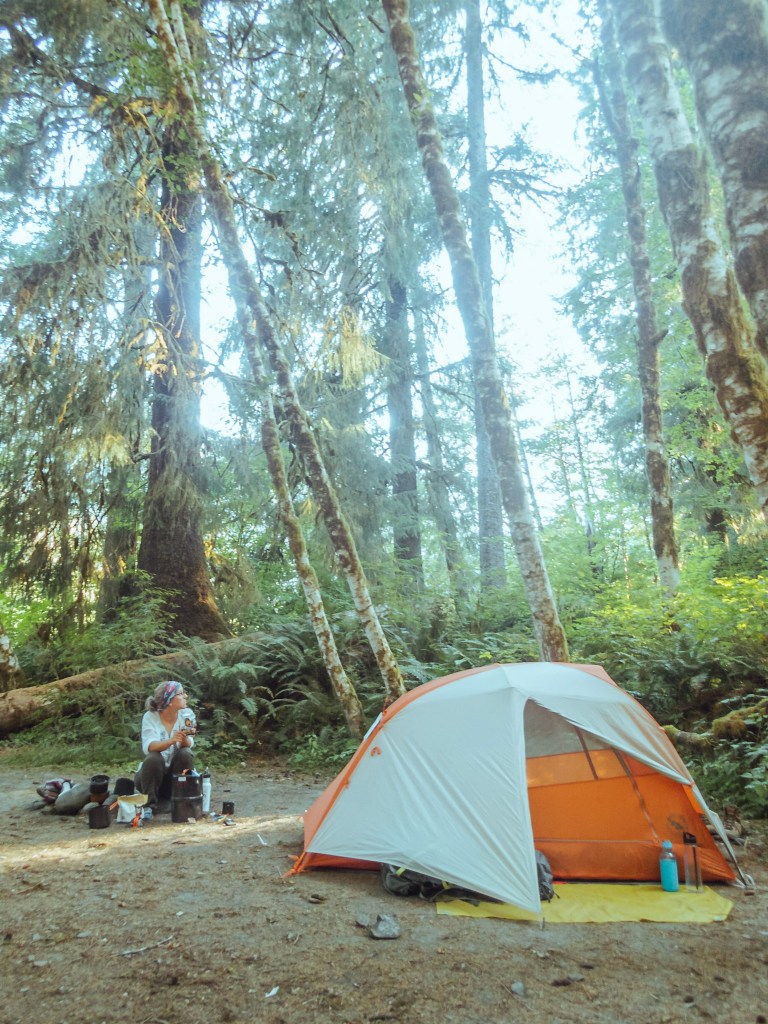
Ultimately, this deep into the wilderness, even that many people clustered together doesn’t feel terribly crowded. We enjoyed our sadly chicken-mushroom-free pouch-meal and passed a pleasant night. I got excited somewhere around 3am because I thought it might have started to rain, but in the morning we discovered it was just tiny leaves falling on our tent.
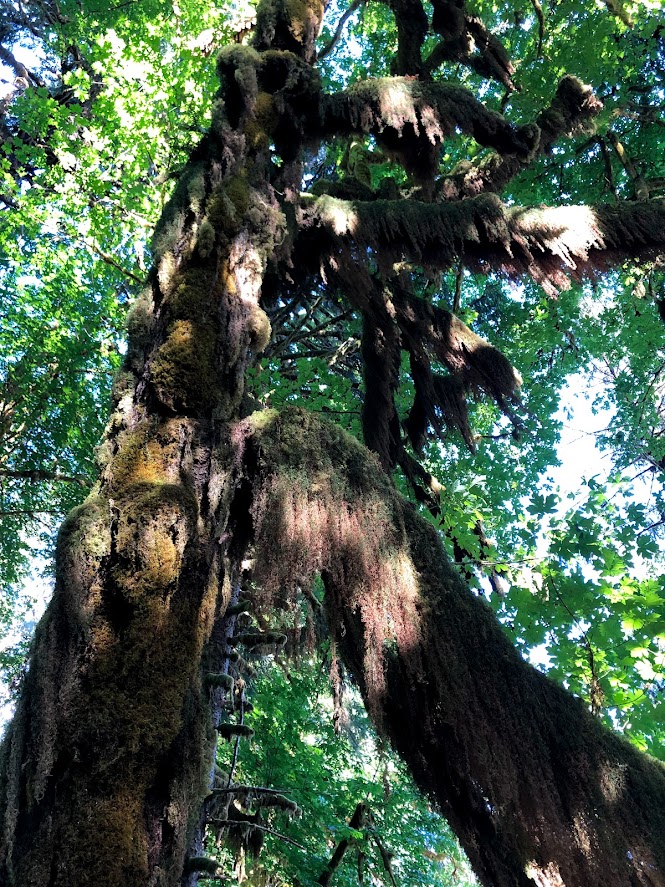
The disadvantage of spending only one night in the Hoh Rainforest is that all you do is follow a straight-line, relatively level trail out, you sleep, and then you follow the same trail back. It is beautiful, yes, but lacked a little of the wow-factor we’ve had on other hikes.
Working our way out, we came across another pair of hikers exiting the rainforest. They were moving at a slower pace than we, and looked tattered and tired. As we pulled past them, I had to ask: “Are you coming from the glacier??”
The man nodded wearily. “We’ve been out six days,” he said. “I broke my shoe.” He looked down at his feet, which were clad in sandals and dust. A pair of hiking boots hung tied to his pack. I’d been in his position once, but when my shoe broke, I’d had nothing to put on my feet but socks. That had only been a three-day hike. How long had this man been wearing sandals?? Long enough that it had washed the splendor of the glacier from his thoughts, anyway.
We wished them luck and the joy of their upcoming showers, and continued to make our way out. Showers and a couple days with a friend in Seattle awaited us on the other end of this hike, and I was looking forward to both.
 Thither & Yon