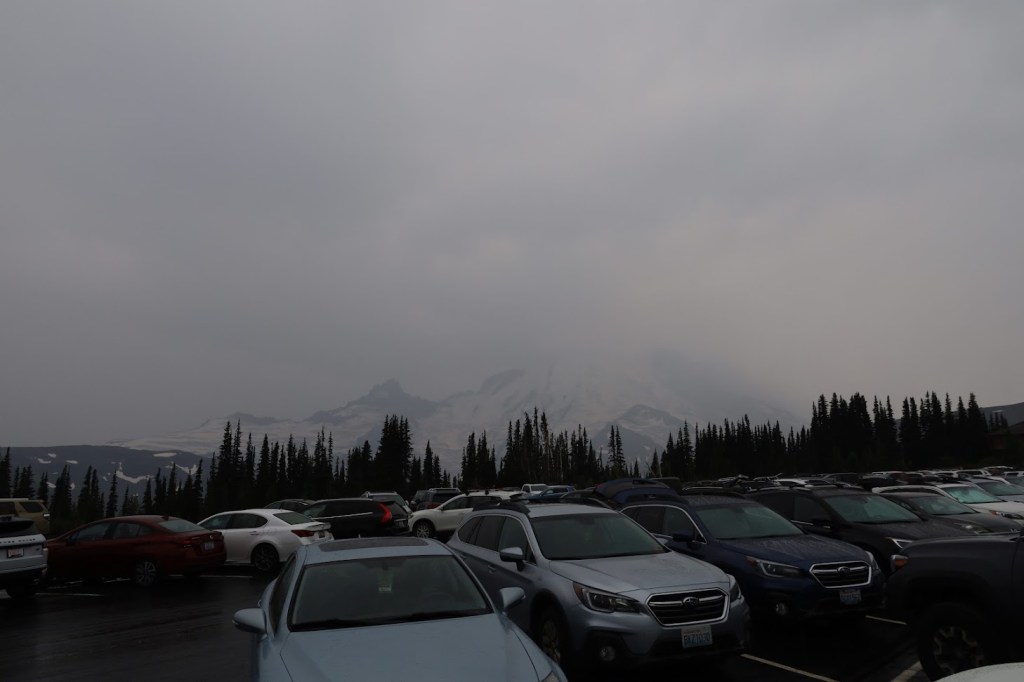
When last we left our intrepid adventurers, they (right, sorry, we) were fleeing Mt. Rainier National Park because we were exhausted from 17 miles of hiking in two days, we didn’t have a place to sleep that didn’t involve at least three more miles of hiking, and it looked like this:
We thought maybe we’d take our chances and move straight on to Olympic National Park. Odds were strong that the weather at Olympic would be about the same, and without a reservation for camping, we could wind up in a bit of a pickle, but Rainier was bleak, Olympic is huge, and an extra day there seemed like a good gamble.
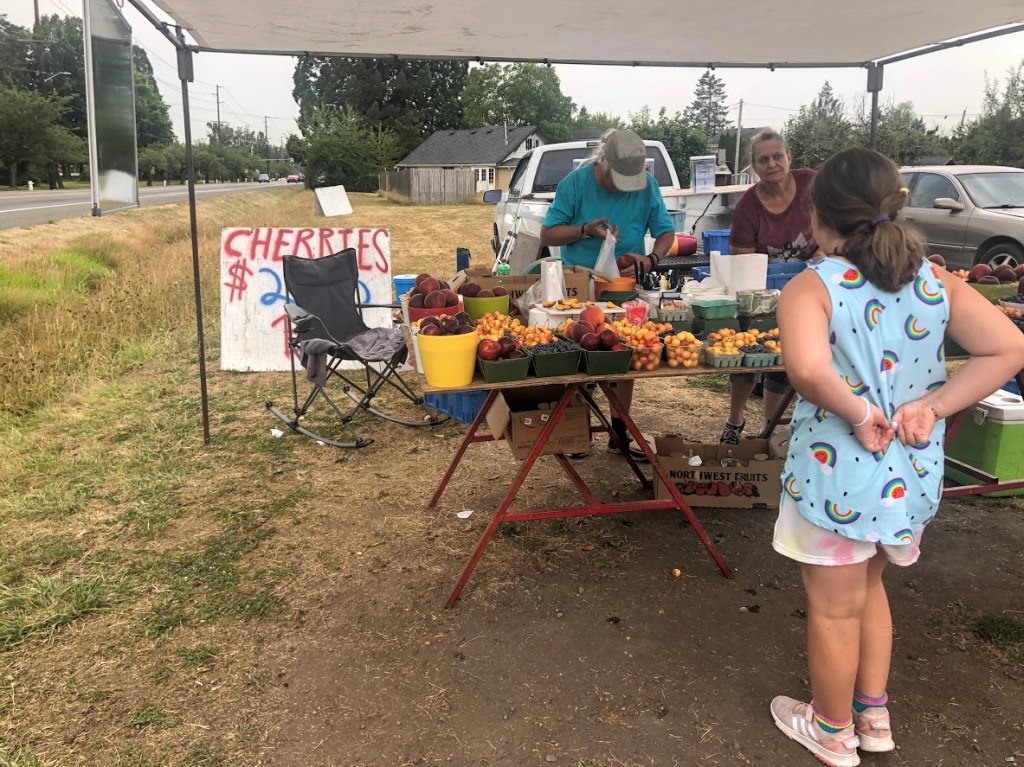
If you’re not familiar with Olympic National Park, it is huge and intimidating. (Now that I’ve taken a hot second to look it up, maybe it’s more intimidating than huge. It’s not even half as big as Yellowstone, and I’m great at Yellowstone.) Every time I tried to work out plans for this park, my eyes went crossed and I gave up.
Unlike my beloved Yellowstone, where even if you’re overwhelmed by the number of things to see you can just drive a circle around the inside of the park and get a little glimpse of many park wonders, there is no “inside” of Olympic. Olympic is like a wheel where none of the spokes go all the way to the middle. Each spoke leads into a different section of the park: rainforest, mountains, forest, beach, another rainforest, more mountains. In order to go from one section to another, you have to leave the park and drive to another spoke/park entrance. The loop road in Yellowstone is 142 miles. The series of highways that circles Olympic is 307 miles. There are no shortcuts.

There are eight entrances to the main body of the park (discounting the long strip of beach that is separated from the rest of the park). The Hoh Rainforest gets a lot of fame (a temperate rainforest?!) so certainly we would have to go there. Hurricane Ridge made a lot of “best” lists, so that went on the list. We’d have to get to the beaches. Staircase got a few nods for being “underappreciated.” A local friend mentioned some lesser-known trails up in the Elwha area. The hot springs at Sol Duc seemed worth investigating.
With Yellowstone as my reference, doing all these things didn’t seem completely out of the question for a four-day visit. It wasn’t until I started looking at hiking and backcountry camping options that I realized my folly.
I immediately started figuring out what kind of hike we’d have to organize to get to Glacier Meadows at the foot of Blue Glacier. That Blue Glacier clings to the upper reaches of fricking MOUNT OLYMPUS should have given me a clue that I was trying to bite off more than I could chews, but… glacier. My fifteen minutes ended and I put the campsite back into my cart. I repeated the process three times before admitting defeat. The shortest possible hike would be 18 miles along the boringest trail. The more interesting hikes started at 22 miles and only got longer from there. And were any of the campsites along the way available? Of course not. No wonder the Glacier Meadows site was still available. Only a superhuman would dare try the whole hike in one day. Availability notwithstanding, going up to see the glacier would cost us the entire length of allotted time at this park, and there was a lot more park we wanted to sample.
I moped off to look at hotel rooms instead.
We secured a room in Sequim (“squim”) near the Hurricane Ridge entrance for what would have been the first night of our stay, and backcountry sites on Third Beach and in the Hoh Rainforest for the second and third nights. Sampling.
But here we were, a night early with no plan and no oomph for hiking in to a backcountry site.
“Let’s go to Staircase,” I proposed. Staircase would have been a possible last-minute add-on if the rest of our time in the park allowed for it. Coming from Rainier, though, it was one of the nearest entrances.
“Where will we sleep?” Dustin asked.
“There are two front-country campgrounds, and if they’re both full we can disperse in the National Forest.” You know we’re getting desperate when front-country camping and dispersed camping (pitching your tent along the side of a road in an approved part of a National Forest) are the best options. Our general philosophy is that if we’re going to go through the discomfort of sleeping in a tent, we really ought to be getting something (a remote, lovely view and serious solitude, usually) out of it. Sleeping in a tent in close proximity to dozens of neighbors? Meh.
But desperate times.
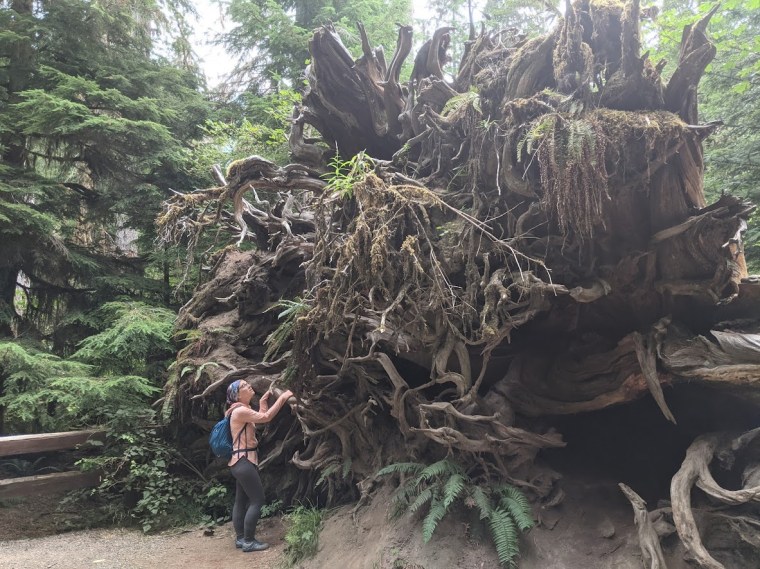
We drove past the first campground (“FULL”) and crossed our fingers that the campground inside the Park would for some reason have an opening when the Forest Service did not. Experience at every park we’d visited so far suggested this was foolish thinking, but we’d gotten lucky before.
“FULL,” announced the sign at the Staircase Ranger Station campground. It was after 5pm and no surprise, but still disappointing.
“Let’s drive through and see,” Dustin suggested. “Just in case.”
A slow prowl revealed a surprisingly large and unsurprisingly full campground. A couple sites did not yet have occupants established, but signs clipped to the site marker showed they were spoken for.
Until one didn’t. We hung out the window of the car, squinting suspiciously at the apparently vacant site.
“Pull in,” I said. “We can sit on it while we figure it out and if someone else comes, we’ll just leave.”
We checked to see if a note had fallen off the site marker. Nope. We checked the reservations board at the entrance. It claimed that this was the second night of a reservation for some guy named Jeff who had an RV. Had Jeff immaculately cleaned up his campsite and pulled his RV out with the intention of coming back? Campground regulations said you had to put your stuff out (tent, RV, whatever) to establish occupancy.
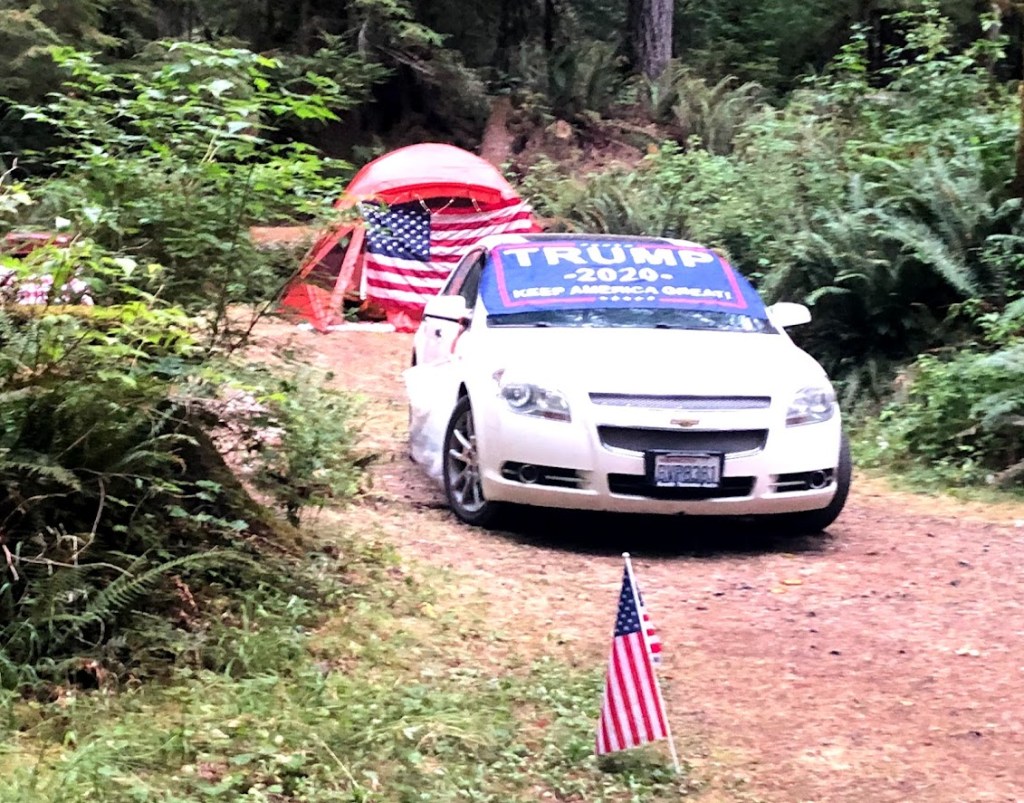
We walked back to the site. Someone was now home at the red and white tent in one of the neighboring sites.
“Do you know if there’s someone using this site?” I asked.
She shrugged. “There were people here earlier, but they left. I’d say it’s yours.”
“Like… how much earlier?” I was sure this was a trap.
“A couple hours?” she suggested. “Possession is nine tenths of the law, though, right?”
At long length, we decided she was probably right. The evidence all pointed to an early abandonment of the site by Jeff, in a manner and at a time that strongly suggested he wasn’t coming back. We went about setting up our site and deciding which abomination of pouch and not-pouch food would be our dinner.
I spent the night in the tent more distracted by the notion that Jeff was going to reappear at any moment and demand his site back than by any of the dogs or children I had eyed with suspicion over dinner. Jeff never did come back, and the dogs and children were remarkably well behaved until sunrise.
There would be no glaciers on this park visit, but we would be getting to visit many of the sections of the park and get a good sampling of what it had to offer, including some local front country color that we’d have missed entirely if not for this little adventure.
 Thither & Yon