This was going to be a story about a kayaking trip.
It’s become something of a habit for us to go kayaking on every new body of water we visit. The bioluminescent tour on the lagoon in St. Croix might have been the first kayaking adventure, followed by Pirate’s Beach, Islas Marietas, and Mismaloya in Jalisco, and Swiftcurrent Lake in Glacier NP (I guess that was a row boat), so when Dustin said, “I found us a kayaking tour out to the arch,” in the early days of our stay in Cabo San Lucas, I wasn’t surprised.
“We’ll kayak out to the arch, then go to Pelican Beach for snorkeling,” he continued.
I wrinkled my nose. On nearly every kayaking trip, we’d also had the opportunity to snorkel, and we’d never done it. Snorkeling just… didn’t appeal.
“I’m sure that part is optional,” Dustin said, seeing my expression. The fee for the trip, however, felt a little high to just skip half of what we would be paying for. Maybe I could at least try it this time? I would probably love it, some part of my brain said, I was just being a weird baby about it. After all, I loved vegetables now, didn’t I? After being a weird baby about them for twenty years?
“What do you think about doing the sunrise tour?” Dustin asked.
I narrowed my eyes. “Is there an alternative?”
“There’s a 9:30 tour,” he said.
This was not I loaded question. If I said, “blah mornings ew nope blah, let’s go at 9:30” he would have said, “okay” and it really would have been okay. He knows my default mode is “ew mornings nope blah,” but my husband is a photographer. The magical things that happen to the light when the sun comes and goes are kind of like candy to him. Even I, in fact, adore the notion of sunrise, if not the practicalities.
“What time is sunrise?” I asked cautiously.
“Around 6:30. The tour would start at 6:00.”
“Like… we’re on the beach crawling into the frigid Pacific Ocean at 6am?”
“Technically, it would be the frigid Gulf of California,” he said.
“The beach that is a half hour walk from the villa?” I persisted.
“Eeyup,” he agreed after a pause during which he failed to think of a way to cushion that dark truth.
I was silent for a moment, weighing the unpleasantness of pre-dawn wake-up calls against what would likely be a spectacular view. I imagined being out on the ocean before all the fishing boats went out, way before the tourist boats went out, and – possibly the most interesting to this sunburn-phobic – before the sun rose high enough to bake my tender flesh.
“Yep, we can do that,” I said.
“You sure?” he asked, sounding a little too surprised.
“Don’t try to talk me out of it unless you want to succeed,” I said.
5:30am is still full-blown nighttime this time of the year, even this far south. When we got up, there was no sign of light. Our villa sat up on the side of the hill, so we picked our way gingerly down steep streets in the dark. We then wound our way through the thousands of smells that comprise an ocean marina, finding our way to Cannery Beach, the starting point for this adventure.
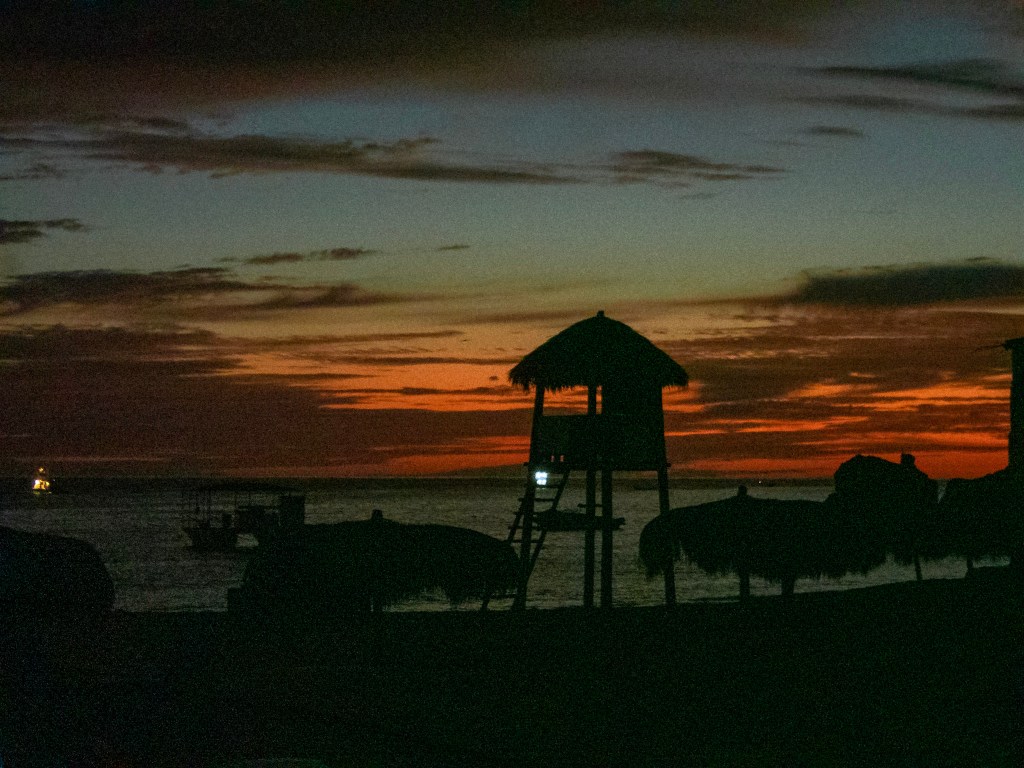
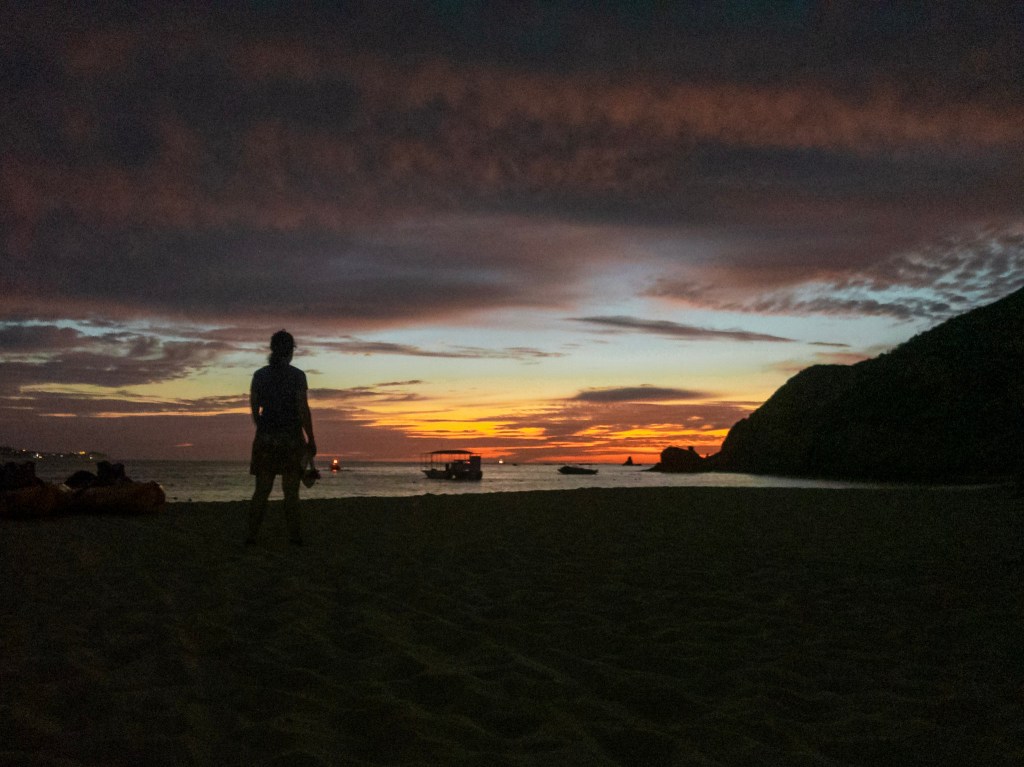
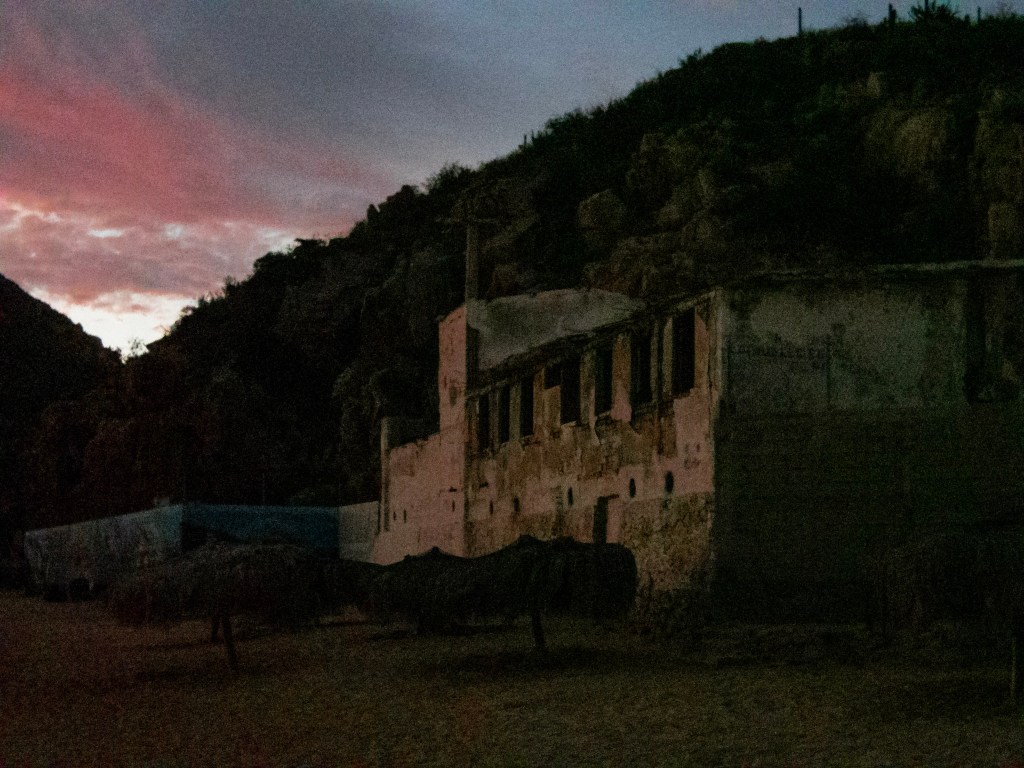
Our host for this adventure was a dude named Hass (“like the avocados!”). He had three rules: wear the life vest, stay close to Hass, and let Hass go in to shore first every time. Both we and the other couple on the tour had experience with kayaks, so we skipped the paddling lessons and headed into the water.
I gritted my teeth and marched into the Pacific as if a frigid ocean plunge was always on my 6am to-do list and… the water was warm?!
“This is warmer than the pool!” I said as I clambered gracelessly into the front seat of the kayak. This was not actually saying much – the pool at our villa was awfully cold – but still, the Pacific is a cold ocean, and okay maybe we’re actually in the Gulf of California, but the Pacific is RIGHT THERE.

It took Dustin and I a few minutes to get our paddling groove together – mostly because he was taking photos and I was paddling, a very fair arrangement actually – and then we headed out into the sunrise.
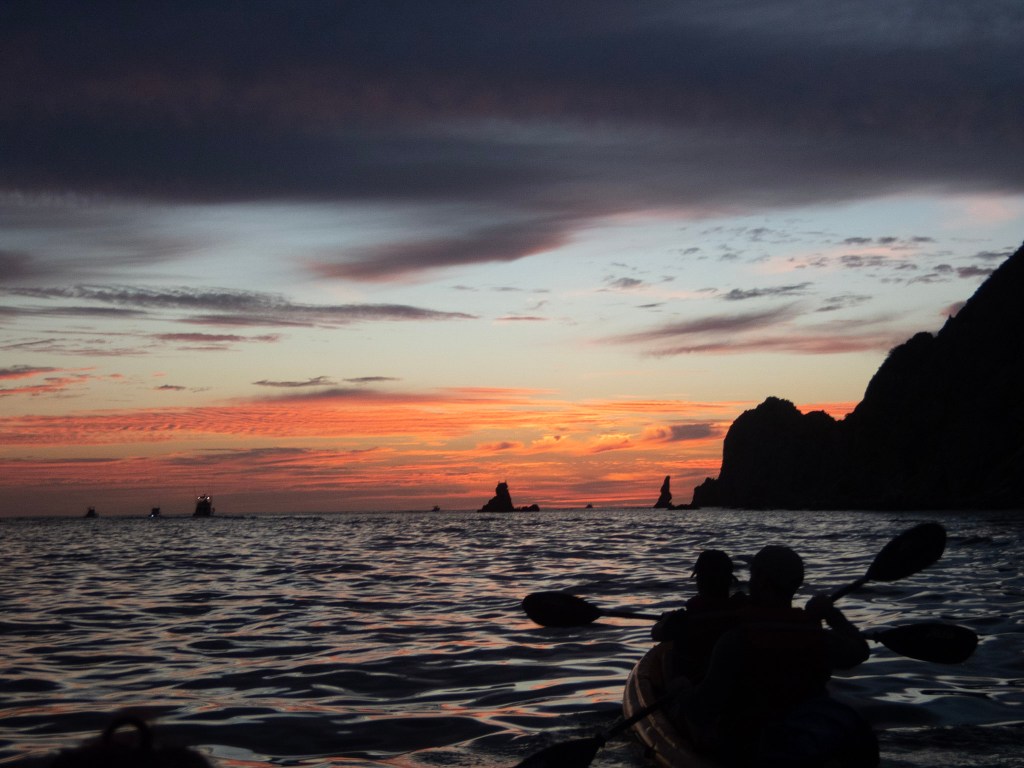
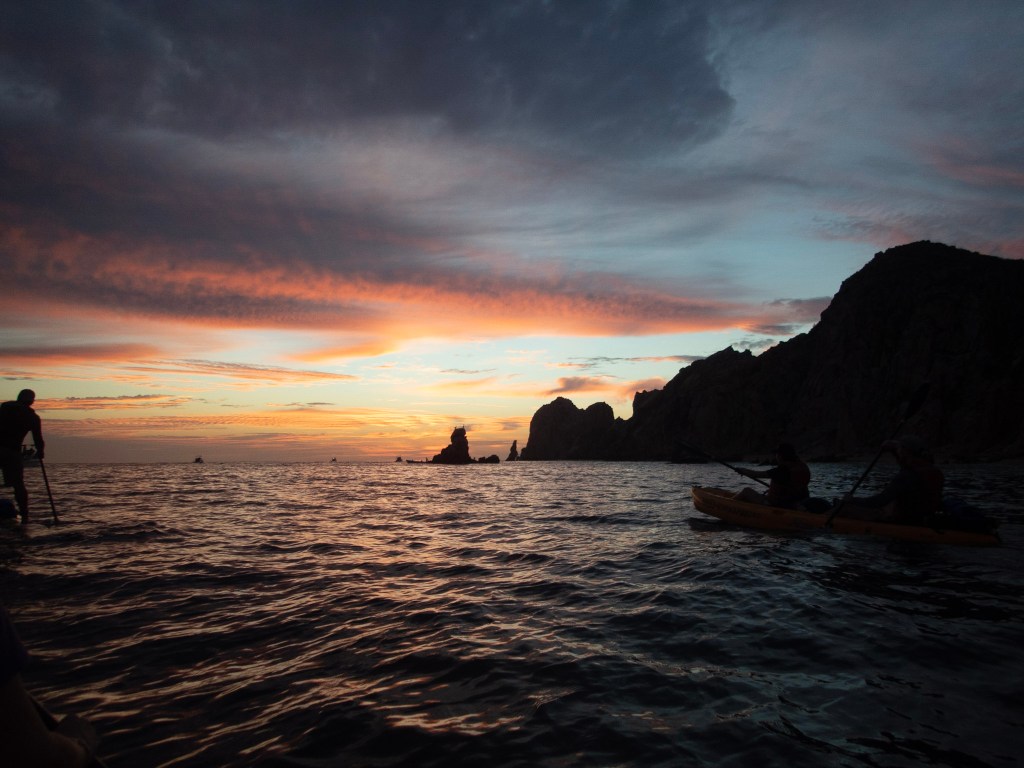
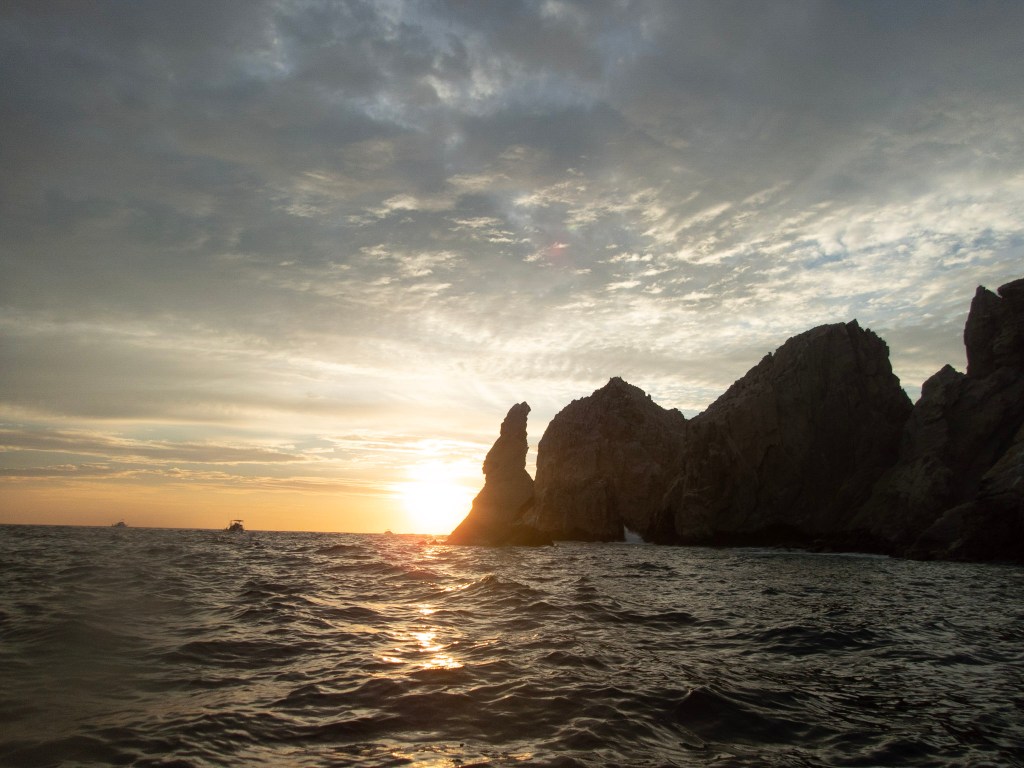

At the very tip of the peninsula are a dozen or more very impressive sea stacks (columns of rock separated from the mainland) and one very impressive arch. The rocks here are mostly granite, with some softer sedimentary intrusions. This arch formed the same way all the arches in Utah formed, as the forces of erosion (in this case some really wild waves) worked away at the softer and weaker spots in the hard rock.
Scale is a little tricky in these photos, but the best info I can find (which is dubious but consistent) says the opening of the arch is “three stories tall,” so probably around 30 feet. It’s a big arch, but this is where the waters of the open Pacific meet the waters of the Gulf, and the waves are… boisterous. This was as close as we could safely get.
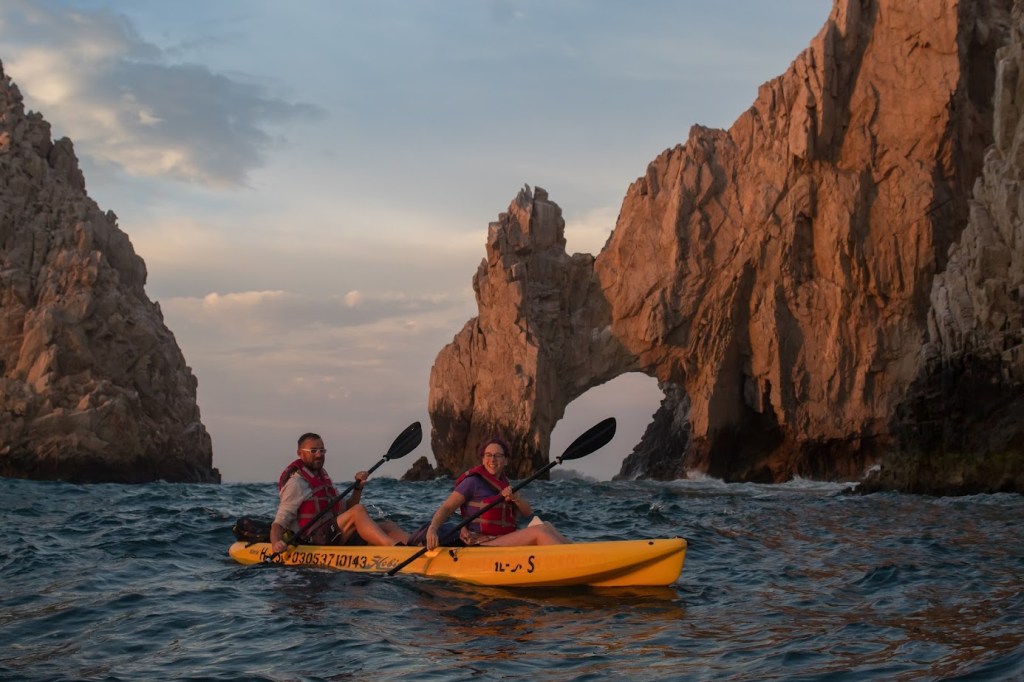
We spent a few minutes getting our photos and admiring the glory of the morning before turning around and heading back along the coast. At Lover’s Beach we paused while Hass rowed in to test the viability of landing there for a while, but the waves were too rambunctious. Instead we paused for story time.
“Do you know why it’s called Lover’s Beach?” Hass asked.
“Because the waves here are calmer than they are on the Pacific side, at Divorce Beach,” I say exactly like the know-it-all I am. I learned about that on the glass-bottom boat we took on our trip ten years ago. The beach stretches the width of the entire peninsula so you can be on both the ocean and gulf coasts when you visit it. The waves on the Divorce Beach side really were frightful in my recollection.
“That’s what the tour brochures say,” Hass said, deflating me somewhat. “But the story the locals tell is different.” Hass had heard this story from a cousin or a friend who’d lived here her whole long life, and she knew the people originally involved. Or so the story goes.
“There was a young woman from France who came to stay here in Cabo,” Hass said. “She found a room living with a woman from the community. Eventually, the woman started to notice that the girl’s clothing was very fine, and her makeup was always done up, and that the girl always seemed to leave in the evenings and return in the mornings. Well, you can guess what she was up to, and so did the woman. The woman was too respectable to host a girl like that, though, and told the girl to leave. And so the girl came to Lover’s Beach to ply her trade instead. She built a shack on the beach and kept plenty busy, and since no one else lived out here, no one could complain.
“That story isn’t so good for the tourists,” Hass added as an afterthought. I’m not so sure Hass has been paying attention to the current state of world affairs, but I guess I can see why the chamber of commerce might not put that in their literature.
Not much farther down the coast we came to Pelican Beach, so named for the sea stack nearby that is almost constantly graced with a pelican or three. Today, instead of having pelican décor, it hosted a very sleepy sea lion.
Pelican Beach is an exceptional place for snorkeling, making it one of the most common stops for tour boats and groups like ours. At just after 7am, though, we had the place entirely to ourselves.
Hass gave us the all-clear, then helped bring our kayaks onto the shore. Bottles of water and granola bars were passed around. Hass pointed out the various snorkeling highlights while we munched.
“The tour boats drop bread over there by the ropes,” he said, indicating the ropes that marked out the safe swimming zone, “so that’s where you’ll see the most fish. Along the rocks is where you might see the rare fish, though. Maybe a sea turtle, or an octopus. If we’re really lucky the sea lions will be in the water.”
I slowed my ravenous granola consumption. “Sea lions in the water? With us?”
“I hope so,” Hass replied.
“And that’s… safe?” Sea lions are enormous. Males can weigh more than 800 pounds. What if it confused me for a herring? I’m not very big. Or a quadropus?
“It’s safe,” Hass said. “Don’t try to touch them, but just swimming with them is totally fine.”
By now, Hass had the snorkeling gear out and had passed two sets to our fellow tourees. Confession time.
“So, uh, I’ve never actually snorkeled before,” I said.
This was a lie. I had snorkeled before, though it had been decades. Literally. The last time I had snorkeled had been in my grandfather’s pool in California. I must have been about seven. I’d yanked on the flimsy yellow mask and tube and plunged right in, convinced this miraculous new apparatus was about to turn me into a mermaid who could breath underwater forever. Instead, I’d gotten a lung full of pool water.
My mer-determination must have been reasonably strong, as instead of giving up straight away, I fought with the mask and tube, trying to get the tube to stay out of the water instead of flopping into the water at random intervals. All efforts ended with lungs full of water. I may not have been a fast learner, but once I figured out that snorkels were just a way to look fancy while not being able to breath underwater, I never felt any urge to try again no matter how many photos of rainbow fish the brochures displayed.
Fortunately, my deep loathing of wasting money can occasionally prove motivational against even deeply ingrained psychological roadblocks.
“I get the general theory,” I continued, staring doubtfully at the mask and tube, “but what are the specifics I should know?”
Hass wasn’t at all phased to have a rookie in his crew. “The hardest thing about snorkeling is breathing only through your mouth. People aren’t used to it.” Hass did not know I’m a professional (though trying SO hard to reform) mouth-breather. He advised me to put the mask on and practice breathing through my mouth before getting in the water. I was surprised at how completely the mask cut off my ability to use my nose even if I had wanted to.
Juggling the equipment in the water as we moved past the breakers was harder than I had expected. Flippers are hella clumsy when they aren’t yet attached to your feet. Figuring out how to get the flippers onto my feet without dunking myself only caused me to wash back up onto the beach. Getting back out past the breakers while wearing one flipper turned the whole situation into slapstick.
The first thing I did once I had both flippers secured to my feet was kick a fish. I’m sorry, fish, I really didn’t mean to.
“The only other important thing to remember,” Hass had said after instructing us to blow firmly through the snorkel tube each time we put it into our mouths, “is to breathe slowly. If you breathe slowly, even if you get some water in the tube, you shouldn’t actually inhale it.”
I chomped on my tube, lowered my face into the ocean, opened my eyes to see a whole herd of colorful fish, and promptly started hyperventilating.
It wasn’t the fishes’ faults. It wasn’t because I couldn’t get enough air. It wasn’t the knowledge that the entire weight of the world’s oceans was pressing down on me. Even though the air was flowing just fine with no sign that my tube was filling up with water or carbon dioxide, my brain refused to believe enough oxygen could possibly be available in a world where no oxygen was visible.
I popped my head out of the water, kicking a couple more fish (sorry, fish!), spat out the mouthpiece and looked around. Everyone else was still working out their equipment, too. Hass was advising Dustin on something to do with his mask, and the other couple was dipping their heads in and out of the water. One of them had elected to keep her life vest on, and I wondered if that hadn’t been a good idea. Nobody was panicking or suffocating.
Snorkeling has a long, storied history of people not suffocating, I reminded myself. If people suffocated on the regular, it would not be so popular.
I took a couple reassuring breaths without the tube, then chomped back down. Face in the water, take a slow breath, no water in the tube. I felt the urge to gasp, to chase the air in case it was running away, but I forced myself to focus only on breathing – not on flippers, not on fish, not on the other people – until my body started to believe the oxygen supply was not a lie. I allowed my legs to float to the surface. A tornado of tropical fish swam beneath me.
Whoa.
I floated for several minutes as my confidence in my access to oxygen ebbed and flowed. When several minutes had passed and I had not yet inhaled any water at all, I started to relax and attempted a tentative kick away from the rope, deeper into the swarm of fish.
It turns out, of course, that snorkeling is amazing.
We stayed among the cloud of fish for awhile before heading toward Pelican Rock. Hass had instructed us to keep some distance between us and the rocks, which are sharp on their own, but also covered with sharp creatures. I did not need this warning; I was convinced everything in the ocean secretly or not-so-secretly wanted to bite me or slice me.
I did, however, scan the rocks intently for any signs of octopi. I really wanted to see one. Cephalopods are so cool.
And then I heard the sea lion. Those guys are loud. How can I even spell the sound they make?
AAAAUUUWWWRRRRRR! AAAAAUUWWRRRRRR! AUUUUWWRRRR!
I popped my head out of the water and found myself face-to-face with the sea lion lounging on Pelican Rock.
(Okay, fine, not face-to-face. He was a solid six feet above me. And also was probably a she, given her size. Still, it was very startling.)
“Look there!” said Hass, who had surfaced about ten feet away. A dark streak shot past beneath us. I stuck my face back into the water in time to see a second sea lion turn back toward the rock and then shoot to upward. I resurfaced and saw his sleek head poking out of the water less than a dozen feet away. He barked up at his buddy on the rock, who soundly ignored him.
“This is really okay?” I squeaked at Hass.
“It really is,” he confirmed. An aggressive sea lion, Hass continued (to the best of my recollection… I can’t confirm this so assume any misinformation in this statement is mine and not Hass’s), would get out of the water and scold the object of its ire from a dominant position before diving back into the water to give chase.
“Don’t annoy the sea lions out of the water,” I chanted to myself. They made me nervous, yes, but I wasn’t nervous enough to swim away and miss out on this up-close display. Eventually, the swimming sea lion got bored with his sleepy buddy and disappeared into the abyss.
Hass then tempted the others to abandon their gear on Pelican Rock and to a nice jump off the top. For my part, I’d invested all my angst into figuring out how to snorkel, so I figured I’d spend all of my currency doing that. While the others climbed up the rock, I flippered off to inspect the other rocks along the shore. Surely an octopus must be waiting for me somewhere.
I saw needlefish and angelfish and rainbow fish and black fish and I don’t even know what fish because I didn’t taken any pictures and the field guides I can find online are terrible. So many fish. Not a single one of them tried to bite or slice me.
And then.
Shortly after Hass and company had returned from their little cliff-jumping expedition, I was quizzing Hass about some of the things I’d seen – something like confetti, no bigger than lentils but glowing the most unearthly shade of day-glo blue, had floated past me just a moment before. Probably, Hass speculated, it had been scales shed by the juvenile form of the black fish we’d seen so many of. Ohhh, I said in wonder.
Then, “Oh!” I said in surprise. Then, “Oh, oh, hey, ow ow ow.” My arm tingled. It felt like I’d brushed it up against some irritating plant.
“Something tickling?” Hass asked.
“Oh, hey, hey, what the.. hey…” I kept saying, rubbing at my arm where absolutely nothing appeared to be wrong. “It stings,” I finally managed to clarify. Then added a few more “oh”s and “hey”s for good measure.
“Maybe a little jellyfish,” Hass said. “It will sting for about five minutes, then you’ll be fine.”
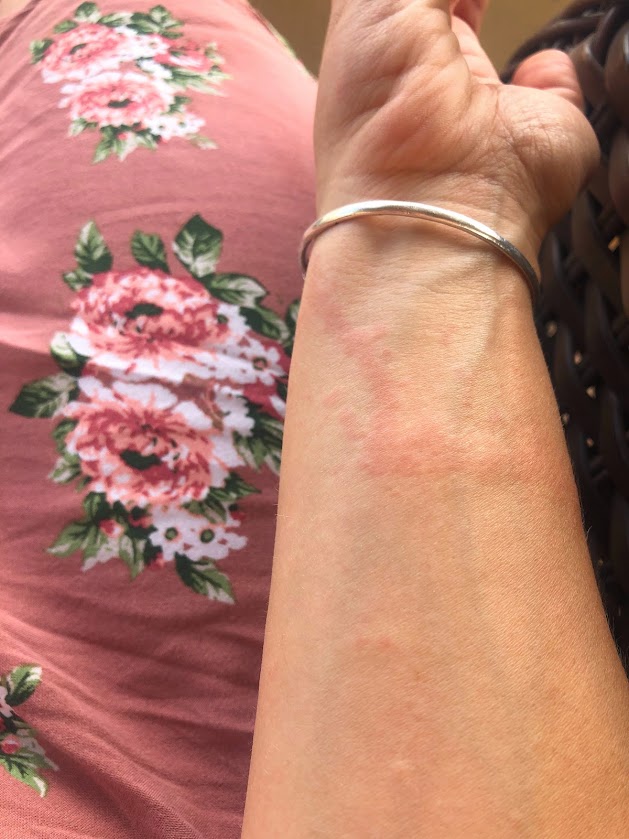
I looked around at the surface of the ocean as if a guilty jellyfish might be bobbing in the waves nearby. My skin prickled – not pain, exactly, but definitely irritation. I could see red marks starting to appear around my wrist.
“Are there many jellyfish out here?” I asked.
“Hardly any,” Hass said. “That probably wasn’t even what it was. It could’ve been slksdfwejf.” (He used a real word, but afterward I couldn’t for the life of me remember what alternative he had proposed.)
We only had a little time left, so I took my stinging arm off to annoy some needlefish and give my octopus one more chance to show himself. I kept an eye out for jellyfish, too, though I suspected by the time I saw one, it might be too late to properly avoid it.
Back out of the water fifteen minutes later, I inspected my still-stinging arm. I had a definite welt, running from near my right elbow around my wrist and up the back of my hand.
“It might sting for an hour or so,” Hass said, editing his earlier pronouncement. “And then you won’t even notice it.
Once out of the water and somewhat dry, we made a short tour of the beach itself, which was incredibly beautiful.
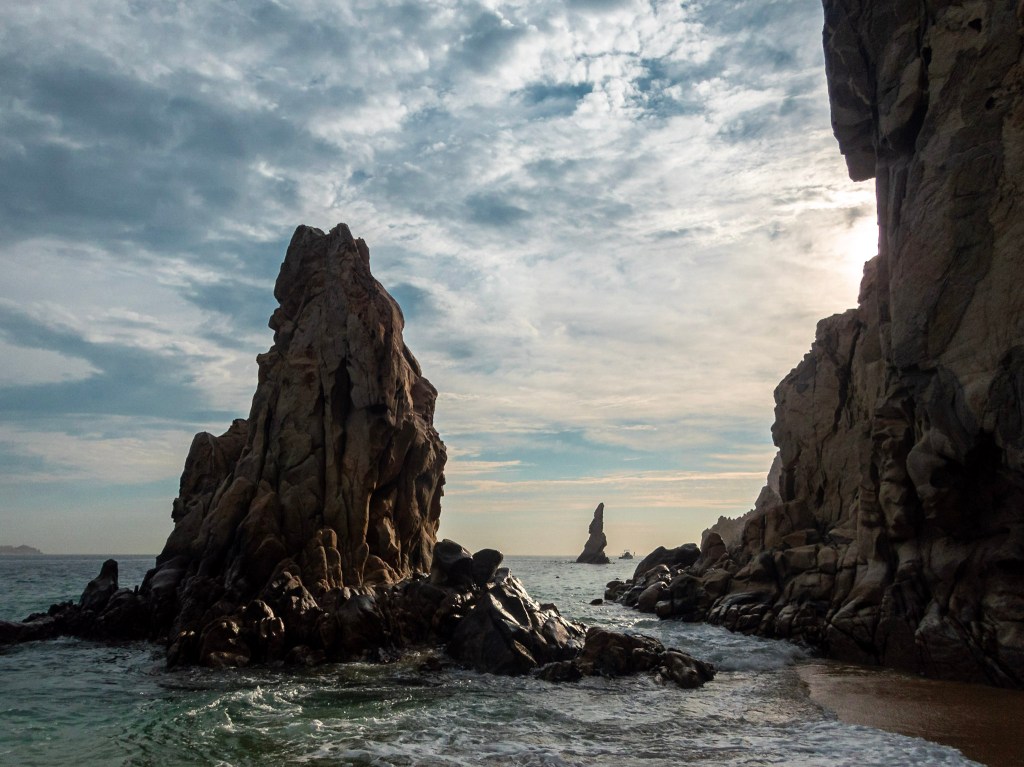
The trip back into Cannery Beach was short and sweet. The first tour boats of the day had started arriving at Pelican Beach just as we pulled out, and I was again grateful we’d elected to do the sunrise tour.
We arrived back at the villa, less than an hour late for breakfast, with more than four hours of the day already behind us. I munched on my spinach omelet and asked Ye Internet if he could confirm whether I had been jellyfished, or if it might have been something else.
“Stinging hydroid? Sea lice? String of pearls?” he suggested.
I looked up the specifics of one after another and dismissed each. Too not-stringy, too small, too rare (and also the wrong ocean). Jellyfish it was, then.
If you’d told me the night before that I’d be trying to breathe through a tube and getting stung by a jellyfish for my efforts, I probably would have canceled – pricetag be damned – but in the end, I and kind of delighted by having done both of those things.
Maybe next time I’ll find a way to bring a camera.
 Thither & Yon